HI83399 benchtop photometer measures 40 different key water and wastewater quality parameters using 73 different methods that allow for multiple ranges and variations in chemistry for specific applications. The Chemical Oxygen Demand (COD) parameter is included for industrial and municipal wastewater treatment. The Phosphorous and Nitrogen parameters included are beneficial to municipal wastewater treatment customers that need to monitor their biological and chemical nutrient removal process. This photometer features an innovative optical system that uses LEDS, narrow band interference filters, focusing lens and both a silicon photodetector for absorbance measurement and a reference detector to maintain a consistent light source ensures accurate and repeatable photometric readings every time.
A digital pH electrode input is provided allowing the user to measure pH by a traditional glass electrode. The digital pH electrode has a built in microchip within the probe that stores all of the calibration information. Having the calibration information stored in the probe allows for hot swapping of pH electrodes without having to recalibrate. All pH measurements are automatically compensated for temperature variations with a built in thermistor located in the tip of the sensing bulb for fast and accurate temperature measurement.
Two USB ports are provided for transferring data to a flash drive or computer and to use as a power source for the meter. For added convenience and portability the meter can also operate on an internal 3.7 VDC Lithium-polymer rechargeable battery.
The HI83399 offers an absorbance measuring mode that allows for CAL Check standards to be used to validate the performance of the system. The absorbance mode allows the user to select one of the 5 wavelengths of light (420 nm, 466 nm, 525 nm, 575 nm, and 610 nm) to measure and plot their own concentration versus absorbance mode. This is useful for users with their own chemical method and for education to teach the concept of absorbance by using the Beer-Lambert Law.
Features/Benefits:
Backlit 128 x 64 Pixel Graphic LCD Display
- Backlit graphic display allows for easy viewing in low light conditions
- The 128 x 64 Pixel LCD allows for a simplified user interface with virtual keys and on-screen help to guide the user through use of the meter
Built-in Reaction Timer for Photometric Measurements
- The measurement is taken after the countdown timer expires.
- Countdown timer ensures that all readings are taken at the appropriate reaction intervals regardless of user for better consistency in measurements
Absorbance mode
- Hanna’s exclusive CAL Check cuvettes for validation of light source and detector
- Allows for the user to plot concentration versus absorbance for a specific wavelength for use with user supplied chemistry or for teaching principles of photometry
Units of Measure
- Appropriate unit of measure along with chemical form is displayed along with reading
Result Conversion
- Automatically convert readings to other chemical forms with the touch of a button
Cuvette Cover
- Aids in preventing stray light from affecting measurements
Digital pH Electrode Input
- Measure pH and temperature with a single probe
- Good Laboratory Practice (GLP) to track calibration information including date, time, buffers used, offset and slope for traceability
- pH CAL Check alerts user to potential problems during the calibration process
- Space saving having a pH meter and photometer built into one meter
Data Logging
- Up to 1000 photometric and pH readings can be stored by simply pressing the dedicated LOG button. Logged readings are just as easily recalled by pressing the RCL button
- Sample ID and User ID information can be added to a logged reading using alphanumeric keypad
Connectivity
- Logged readings can be quickly and easily transferred to a flash drive using the USB-A host port or to a computer using the micro USB-B port
- Data is exported as a .CSV file for use with common spreadsheet programs
Battery Status Indicator
- Indicates the amount of battery life left
Error Messages
- Photometric error messages include no cap, high zero, and standard too low
- pH calibration messages include clean electrode, check buffer and check probe
On-screen Features

Method Selection
Users can easily select any one of the 60 measurement methods via the dedicated METHOD button.

Data Logging
Up to 1000 measurement readings can be logged with user and sample ID and recalled for future use.

pH Measurement Mode
Selecting the pH measurement mode allows for the photometer to be used as a professional pH meter with many features including temperature compensated measurements, automatic two point calibration, and GLP.
Digestion Parameters Features

Cuvette Adapter
The HI83399 is supplied with a 16 mm cuvette adapter that accepts digestion vials.

Digestion Vial Methods
Compatible with COD (EPA, ISO, and mercury free methods), Nitrogen and Phosphorous reagetns packaged in 16 mm digestion vial. Reagents are sold separately.

COD Reactor for Digestion Vials
A COD reactor is used to heat the digestion vials. The digestion vials must be heated to a specific temperature for a period time making the HI839800 an important accessory required to have a complete wastewater treatment monitoring system.
Advanced Optical System
HI83300 is designed with an innovative optical system that incorporates a beam splitter so that light can be used for absorbance readings and for a reference detector. The reference detector monitors the intensity of light and modulates when there is drift due to power fluctuation or the heating of the optical components. Each part has an important role in providing unparalleled performance from a photometer.

High Efficiency LED Light Source
An LED light source offers superior performance as compared to a tungsten lamp. LEDs have a much higher luminous efficiency, providing more light while using less power. They also produce very little heat, which could otherwise affect the optical components an electronic stability. LEDs are available in a wide array of wavelengths, whereas tungsten lamps are supposed to be white light (all wavelengths of visible light) but actually have a poor blue/violet light output.
High Quality Narrow Band Interference Filters
The narrow band interference filter not only ensure greater wavelength accuracy (± 1 nm) but are extremely efficient. The filters used allow up to 95% of the light from the LED to be transmitted as compared to other filters that are only 75% efficient. The higher efficiency allows for a brighter, stronger light source. The end result is higher measurement stability and less wavelength error.
Reference Detector for a Stable Light Source
A beam splitter is used as part of the internal reference system of the HI83300 photometer. The reference detector compensates for any drift due to power fluctuations or ambient temperature changes. Now you can rely on a stable source of light between your blank (zero) measurement and sample measurement.
Large Cuvette Size
The sample cell of the HI83300 fits a round, glass cuvette with a 25 mm path length. Along with the advanced optical components, the larger size of the cuvette greatly reduces errors in rotation from the indexing mark of the cuvettes. The relatively long path length of the sample cuvette allows the light to pass through more of the sample solution, ensuring accurate measurements even in low absorbance samples.
Focusing Lens for Greater Light Yield
Adding a focusing lens to the optical path allows for the collection of all of the light that exits the cuvette and focusing the light on the silicon photo detector. This novel approach to photometric measurements cancels the errors from imperfections and scratches present in the glass cuvette eliminating the need to index the cuvette.
HI83399 is supplied with sample cuvettes and caps (4 ea.), cloth for wiping cuvettes, USB to micro USB cable connector, power adapter and instruction manual.
| SKU | HI83399-01 |
| Name | Water & Wastewater Multiparameter (with COD) Photometer and pH meter – HI83399 |
| pH Range | Photometer: 6.5 to 8.5 pH pH electrode: -2.00 to 16.00 pH |
| pH Resolution | Photometer: 0.1 pH pH electrode: 0.01 pH |
| pH Accuracy | Photometer: ?0.1 pH pH electrode: ?0.01 pH |
| pH Calibration | Automatic one or two point calibration with one set of standard buffers available (4.01, 6.86, 7.01, 9.18, 10.01) |
| pH Temperature Compensation | Automatic (-5.0 to 100.0 ℃; 23.0 to 212.0 °F); limits reduced based on the pH electrode used |
| pH CAL Check (electrode diagnostics) | clean electrode and check buffer/check probe displayed during calibration |
| pH Method | Photometer: phenol red |
| pH-mV Range | ?1000 mV |
| pH-mV Resolution | 0.1 mV |
| pH-mV Accuracy | ?0.2 mV |
| Dissolved Oxygen Range | 0.0 to 10.0 mg/L (as O2) |
| Dissolved Oxygen Resolution | 0.1 mg/L |
| Dissolved Oxygen Accuracy | ?0.4 mg/L ?3% of reading |
| Dissolved Oxygen Measurement Method | Adaptation of the Standard Methods for the Examination of Water and Wastewater, 18th edition, Azide modified Winkler method |
| Absorbance Range | 0.000 to 4.000 Abs |
| Absorbance Resolution | 0.001 Abs |
| Absorbance Accuracy | ?0.003Abs @ 1.000 Abs |
| Alkalinity Range | Freshwater: 0 to 500 mg/L (as CaCO3) Seawater: 0 to 300 mg/L (as CaCO3) |
| Alkalinity Resolution | 1 mg/L |
| Alkalinity Accuracy | ?5 mg/L ?5% of reading |
| Alkalinity Method | Colorimetric method |
| Aluminum Range | 0.00 to 1.00 mg/L (as Al3+) |
| Aluminum Resolution | 0.01 mg/L |
| Aluminum Accuracy | ?0.04 mg/L ?4% of reading |
| Aluminum Method | Adaptation of the aluminon method |
| Ammonia Range | Low Range: 0.00 to 3.00 mg/L Low Range (16 mm vial): 0.00 to 3.00 mg/L Medium Range: 0.00 to 10.00 mg/L High Range: 0.0 to 100.0 mg/L High Range (16 mm vial): 0.0 to 100.0 mg/L (all as NH3-N) |
| Ammonia Resolution | Low and Medium Range: 0.01 mg/L High Range: 0.1 mg/L |
| Ammonia Accuracy | Low Range: ?0.04 mg/L ?4% of reading Low Range (16 mm vial): ?0.10 mg/L or ?5% of reading Medium Range: ?0.05 mg/L ?5% of reading High range: ?0.5 mg/L ?5% of reading High range (16 mm vial): ?1 mg/L or ?5% of reading |
| Ammonia Method | Adaptation of the ASTM Manual of Water and Environmental Technology, D1426-92, Nessler method |
| Anionic Surfactants Range | 0.00 to 3.50 mg/L (as SDBS) |
| Anionic Surfactants Resolution | 0.01 mg/L |
| Anionic Surfactants Accuracy | ?0.04 mg/L ?3% of reading |
| Anionic Surfactants Method | Adaptation of the USEPA method 425.1 and Standard Methods for the Examination of Water and Wastewater, 20th edition, 5540C, Anionic Surfactants as MBAS |
| Bromine Range | 0.00 to 8.00 mg/L (as Br2) |
| Bromine Resolution | 0.01 mg/L |
| Bromine Accuracy | ?0.08 mg/L ?3% of reading |
| Bromine Method | Adaptation of the Standard Methods for the Examination of Water and Wastewater, 18th edition, DPD method. |
| Calcium Range | Freshwater: 0 to 400 mg/L (as Ca2+) Seawater: 200 to 600 mg/L (as Ca2+) |
| Calcium Resolution | 1 mg/L |
| Calcium Accuracy | Freshwater: ?10 mg/L ?5% of reading Seawater: ?6% of reading |
| Calcium Method | Freshwater: Adaptation of the Oxalate method Seawater: Adaptation of the Zincon method |
| Chemical Oxygen Demand Range | Low Range: 0 to 150 mg/L Medium Range: 0 to 1500 mg/L High Range:0 to 15000 mg/L |
| Chemical Oxygen Demand Resolution | 1 mg/L |
| Chemical Oxygen Demand Accuracy | Low Range: ?5 mg/L ?4% of reading Medium Range: ?15 mg/L ?4% of reading High Range: ?150 mg/L ?2% of reading |
| Chemical Oxygen Demand Method | Adaptation of the USEPA 410.4 ISO dichromate methods Mercury-free dichromate green method (LR & MR); dichromate method (HR) |
| Chloride Range | 0.0 to 20.0 mg/L (as Cl?) |
| Chloride Resolution | 0.1 mg/L |
| Chloride Accuracy | ?0.5 mg/L ?6% of reading at 25 ?C |
| Chlorine Dioxide Range | 0.00 to 2.00 mg/L (as ClO2) |
| Chlorine Dioxide Resolution | 0.01 mg/L |
| Chlorine Dioxide Accuracy | ?0.10 mg/L ?5% of reading |
| Chlorine Dioxide Method | Adaptation of the Chlorophenol Red method. |
| Free Chlorine Range | 0.00 to 5.00 mg/L (as Cl2) Ultra Low Range: 0.000 to 0.500 mg/L (as Cl2) |
| Free Chlorine Resolution | 0.01 mg/L Ultra Low Range: 0.001 mg/L |
| Free Chlorine Accuracy | ?0.03 mg/L ?3% of reading Ultra Low Range: ?0.020 mg/L ?3% of reading |
| Total Chlorine Range | 0.00 to 5.00 mg/L (as Cl2) Ultra Low Range: 0.000 to 0.500 mg/L (as Cl2) Ultra High Range: 0 to 500 mg/L (as Cl2) |
| Total Chlorine Resolution | 0.01 mg/L Ultra Low Range: 0.001 mg/L Ultra High Range:1 mg/L |
| Total Chlorine Accuracy | ?0.03 mg/L ?3% of reading Ultra Low Range: ?0.020 mg/L ?3% of reading Ultra High Range: ?3 mg/L ?3% of reading |
| Chlorine Method | Adaptation of the EPA 330.5 DPD method Free Chlorine (ULR) & Total Chlorine (UHR): Adaptation of the Standard Methods for Examination of Water and Wastewater, 20th edition, 4500-Cl |
| Chromium, Hexavalent Range | Low Range: 0 to 300 µg/L (as Cr6+) High Range: 0 to 1000 µg/L (as Cr6+) |
| Chromium, Hexavalent Resolution | 1 µg/L |
| Chromium, Hexavalent Accuracy | Low Range: ?1 µg/L ?4% of reading High Range: ?5 µg/L ?4% of reading |
| Chromium, Hexavalent Method | Adaptation of the ASTM Manual of Water and Environmental Technology, D1687-92, Diphenylcarbohydrazide method. |
| Color, Water Range | 0 to 500 PCU (Platinum Cobalt Units) |
| Color, Water Resolution | 1 PCU |
| Color, Water Accuracy | ?10 PCU ?5% of reading |
| Color, Water Method | Adaptation of the Standard Methods for the Examination of Water and Wastewater, 18th edition, Colorimetric Platinum Cobalt method. |
| Copper Range | Low Range: 0.000 to 1.500 mg/L (as Cu2+) High range: 0.00 to 5.00 mg/L (as Cu2+) |
| Copper Resolution | 0.001 mg/L; 0.01 mg/L |
| Copper Accuracy | Low Range: ?0.01 mg/L ?5% of reading High Range ?0.02 mg/L ?4% of reading |
| Copper Method | Adaptation of the EPA bicinchoninate method |
| Cyanuric Acid Range | 0 to 80 mg/L (as CYA) |
| Cyanuric Acid Resolution | 1 mg/L |
| Cyanuric Acid Accuracy | ?1 mg/L ?15% of reading |
| Cyanuric Acid Method | Adaptation of the turbidimetric method |
| Fluoride Range | Low Range: 0.00 to 2.00 mg/L (as F–) High range: 0.0 to 20.0 mg/L (as F–) |
| Fluoride Resolution | 0.01 mg/L; 0.1 mg/L |
| Fluoride Accuracy | Low Range: ?0.03 mg/L ?3% of reading High Range: ?0.5 mg/L ?3% of reading |
| Fluoride Method | Adaptation of the Standard Methods for the Examination of Water and Wastewater, 18th edition, SPADNS method |
| Hardness, Total Range | Low Range: 0 to 250 mg/L (as CaCO3) Medium Range: 200 to 500 mg/L (as CaCO3) High Range: 400 to 750 mg/L (as CaCO3) |
| Hardness, Total Resolution | 1 mg/L |
| Hardness, Total Accuracy | Low Range: ?5 mg/L ?4% of reading Medium Range: ?7 mg/L ?3% of reading High Range: ?10 mg/L ?2% of reading |
| Hardness, Total Method | Adaptation of the EPA recommended method 130.1 |
| Hardness, Calcium Range | 0.00 to 2.70 mg/L (as CaCO3) |
| Hardness, Calcium Resolution | 0.01 mg/L |
| Hardness, Calcium Accuracy | ?0.11 mg/L ?5% of reading |
| Hardness, Calcium Method | Adaptation of the Standard Methods for the Examination of Water and Wastewater, 18th edition, Calmagite method |
| Hardness, Magnesium Range | 0.00 to 2.00 mg/L (as CaCO3) |
| Hardness, Magnesium Resolution | 0.01 mg/L |
| Hardness, Magnesium Accuracy | ?0.11 mg/L ?5% of reading |
| Hardness, Magnesium Method | Adaptation of the Standard Methods for the Examination of Water and Wastewater, 18th edition, EDTA Colorimetric method |
| You know what the French people say | Bodhidharma |
| Hydrazine Range | 0 to 400 µg/L (as N2H4) |
| Hydrazine Resolution | 1 µg/L |
| Hydrazine Accuracy | ?4% of full scale reading |
| Hydrazine Method | Adaptation of the ASTM Manual of Water and Environmental Technology, method D1385-88, p-Dimethylaminobenzaldehyde method |
| Iodine Range | 0.0 to 12.5 mg/L (as I2) |
| Iodine Resolution | 0.1 mg/L |
| Iodine Accuracy | ?0.1 mg/L ?5% of reading |
| Iodine Method | Adaptation of the Standard Methods for the Examination of Water and Wastewater, 18th edition, DPD method |
| Iron Range | Low Range: 0.000 to 1.600 mg/L (as Fe) High Range: 0.00 to 5.00 mg/L (as Fe) |
| Iron Resolution | 0.001 mg/L; 0.01 mg/L |
| Iron Accuracy | Low Range: ?0.01 mg/L ?8% of reading High Range: ?0.04 mg/L ?2% of reading |
| Iron Method | Low Range: Adaptation of the TPTZ Method High Range: Adaptation of Standard Methods for the Examination of Water and Wastewater, 3500-Fe B., Phenanthroline Method |
| Magnesium Range | 0 to 150 mg/L (as Mg2+) |
| Magnesium Resolution | 1 mg/L |
| Magnesium Accuracy | ?5 mg/L ?3% of reading |
| Magnesium Method | Adaptation of the Calmagite method |
| Manganese Range | Low Range: 0 to 300 µg/L (as Mn) High Range: 0.0 to 20.0 (as Mn) |
| Manganese Resolution | 1 µg/L; 0.1 mg/L |
| Manganese Accuracy | Low Range: ?10 µg/L ?3% of reading High Range: ?0.2 mg/L ?3% of reading |
| Manganese Method | Low Range: Adaptation of the PAN Method High Range: Adaptation of the Standard Methods for the Examination of Water and Wastewater, 18th edition, Periodate method |
| Molybdenum Range | 0.0 to 40.0 mg/L (as Mo6+) |
| Molybdenum Resolution | 0.1 mg/L |
| Molybdenum Accuracy | ?0.3 mg/L ?5% of reading |
| Molybdenum Method | Adaptation of the mercaptoacetic acid method |
| Nickel Range | Low Range: 0.000 to 1.000 mg/L (as Ni) High Range: 0.00 to 7.00 g/L (as Ni) |
| Nickel Resolution | 0.001 mg/L; 0.01 g/L |
| Nickel Accuracy | Low range: ?0.010 mg/L ?7% of reading High Range: ?0.07 g/L ?4% of reading |
| Nickel Method | Low Range: Adaptation of the PAN method High Range: Adaptation of the photometric method |
| Nitrate Range | 0.0 to 30.0 mg/L (as NO3–– N) 16 mm vial: 0.0 to 30.0 mg/L (as NO3–– N) |
| Nitrate Resolution | 0.1 mg/L |
| Nitrate Accuracy | ?0.5 mg/L ?10% of reading 16 mm vial: ?1.0 mg/L or ?3% of reading |
| Nitrate Method | Adaptation of the cadmium reduction method 16 mm vial: Chromotropic acid method |
| Nitrite Range | Freshwater Low Range: 0 to 600 µg/L (as NO2–-N) High Range: 0 to 150 mg/L (as NO2–) Seawater Ultra Low Range: 0 to 200 µg/L (as NO2–-N) |
| Nitrite Resolution | Freshwater: 1 µg/L; 1 mg/L Seawater: 1 µg/L |
| Nitrite Accuracy | Freshwater Low Range: ?20 µg/L ?4% of reading High Range: ?4 mg/L ?4% of reading Seawater ?10 µg/L ?4% of reading |
| Nitrite Method | Low Range and Seawater: Adaptation of the EPA Diazotization method 354.1 High Range: Adaptation of the Ferrous Sulfate method |
| Nitrogen, Total Range | Low Range: 0.0 to 25.0 mg/L (as NO3–-N) High Range: 0 to 150 mg/L (as N) |
| Nitrogen, Total Resolution | 0.1 mg/L; 1 mg/L |
| Nitrogen, Total Accuracy | Low Range: ?1.0 mg/L or ?5% of reading High Range: ?3 mg/L or ?4% of reading |
| Nitrogen, Total Method | Chromotropic acid method |
| Oxygen, Scavenger Range | 0 to 1000 µg/L (as DEHA) 0.00 to 1.50 mg/L (as Carbohydrazide) 0.00 to 2.50 mg/L (as Hydroquinone) 0.00 to 4.50 mg/L (as ISO-ascorbic acid) |
| Oxygen, Scavenger Resolution | 1 µg/L (DEHA); 0.01 mg/L |
| Oxygen, Scavenger Accuracy | ?5 µg/L ?5% of reading |
| Oxygen, Scavenger Method | Adaptation of the iron reduction method |
| Ozone Range | 0.00 to 2.00 mg/L (as O3) |
| Ozone Resolution | 0.01 mg/L |
| Ozone Accuracy | ?0.02 mg/L ?3% of reading |
| Ozone Method | Colorimetric DPD Method |
| Phosphate Range | Freshwater Low Range: 0.00 to 2.50 mg/L (as PO43-) High range: 0.0 to 30.0 mg/L(as PO43-) Seawater Ultra Low Range: 0 to 200 µg/L (as P) |
| Phosphate Resolution | Freshwater: 0.01 mg/L; 0.1 mg/L Seawater: 1 µg/L |
| Phosphate Accuracy | Freshwater Low Range: ?0.04 mg/L ?4% of reading High Range: ?1 mg/L ?4% of reading Seawater Ultra Low Range: ?5 µg/L ?5% of reading |
| Phosphate Method | Freshwater Low Range: Adaptation of the Ascorbic Acid method Freshwater High Range and Seawater Ultra Low Range: Adaptation of the Standard Methods for the Examination of Water and Wastewater, 18th edition, Amino Acid method |
| Phosphorous, Acid Hydrolyzable Range | 0.00 to 1.60 mg/L (as P) |
| Phosphorous, Acid Hydrolyzable Resolution | 0.01 mg/L |
| Phosphorous, Acid Hydrolyzable Accuracy | ?0.05 mg/L or ?5% of reading |
| Phosphorous, Acid Hydrolyzable Method | Adaptation of the EPA method 365.2 and Standard Methods for the Examination of Water and Wastewater, 20th edition, 4500-P E, ascorbic acid method |
| Phosphorous, Reactive Range | Low Range: 0.00 to 1.60 mg/L (as P) High Range: 0.0 to 32.6 mg/L (as P) |
| Phosphorous, Reactive Resolution | 0.01 mg/L; 0.1 mg/L |
| Phosphorous, Reactive Accuracy | Low Range: ?0.05 mg/L or ?4% of reading High Range: ?0.5 mg/L or ?4% of reading |
| Phosphorous, Reactive Method | Low Range: Adaptation of Standard Methods for the Examination of Water and Wastewater, 20th edition, ascorbic acid method, and EPA method 365.2 High Range: Adaptation of the vanadomolybdophosphoric acid method. |
| Phosphorous, Total Range | Low Range: 0.00 to 1.15 mg/L (as P) High Range: 0.0 to 32.6 mg/L (as P) |
| Phosphorous, Total Accuracy | Low Range: ?0.05 mg/L or ?6% of reading High Range: ?0.5 mg/L or ?5% of reading |
| Phosphorous, Total Resolution | Low Range: 0.01 mg/L; 0.1 mg/L |
| Phosphorous, Total Method | Low Range: Adaptation of Standard Methods for the Examination of Water and Wastewater, 20th edition, 4500-P E, ascorbic acid method, and EPA method 365.2 High Range: Adaptation of the vanadomolybdophosphoric acid method |
| Potassium Range | 0.0 to 20.0 mg/L (as K) |
| Potassium Resolution | 0.1 mg/L |
| Potassium Accuracy | ?3.0 mg/L ?7% of reading |
| Potassium Method | Adaptation of the Turbidimetric Tetraphenylborate method |
| Silica Range | Low Range: 0.00 to 2.00 mg/L (as SiO2) High Range: 0 to 200 mg/L (as SiO2) |
| Silica Resolution | 0.01 mg/L; 1 mg/L |
| Silica Accuracy | Low Range: ?0.03 mg/L ?3% of reading High Range: ?1 mg/L ?5% of reading |
| Silica Method | Low Range: Adaptation of the ASTM Manual of Water and Environmental Technology, D859, Heteropoly Molybdenum Blue method High Range: Adaptation of the USEPA Method 370.1 and Standard Method 4500-SiO2 |
| Silver Range | 0.000 to 1.000 mg/L (as Ag) |
| Silver Resolution | 0.001 mg/L |
| Silver Accuracy | ?0.020 mg/L ?5% of reading |
| Silver Method | Adaptation of the PAN method |
| Sulfate Range | 0 to 150 mg/L (as SO42-) |
| Sulfate Resolution | 1 mg/L |
| Sulfate Accuracy | ?5 mg/L ?3% of reading |
| Sulfate Method | Turbidimetric – Sulfate is precipitated with barium chloride crystals |
| Zinc Range | 0.00 to 3.00 mg/L (as Zn) |
| Zinc Resolution | 0.01 mg/L |
| Zinc Accuracy | ?0.03 mg/L ?3% of reading |
| Zinc Method | Adaptation of the Standard Methods for the Examination of Water and Wastewater, 18th edition, Zincon method |
| Input Channels | 1 pH electrode input and 5 photometer wavelengths |
| pH Electrode | digital pH electrode (not included) |
| Photometer/Colorimeter Light Source | 5 LEDs with 420 nm, 466 nm, 525 nm, 575 nm, and 610 nm narrow band interference filters |
| Photometer/Colorimeter Light Detector | silicon photodetector |
| Bandpass Filter Bandwidth | 8 nm |
| Bandpass Filter Wavelength Accuracy | ?1 nm |
| Cuvette Type | round, 24.6 mm |
| Number of Methods | 128 max. |
| GLP | calibration data for connected pH electrode |
| Display | 128 x 64 pixel LCD with backlight |
| Logging Type | log on demand with user name and sample ID optional input |
| Logging Memory | 1000 readings |
| Connectivity | USB-A host for flash drive; micro-USB-B for power and computer connectivity |
| Power Supply | 5 VDC USB 2.0 power adapter with USB-A to micro-USB-B cable (included) |
| Battery Type/Life | 3.7 VDC Li-polymer rechargeable battery / >500 photometric measurements or 50 hours of continuous pH measurement |
| Environment | 0 to 50.0 ℃ (32 to 122.0 °F); 0 to 95% RH, non-condensing |
| Weight | 1.0 kg (2.2 lbs.) |
| Dimensions | 206 x 177 x 97 mm (8.1 x 7.0 x 3.8”) |
HI83399 benchtop photometer measures 40 different key water and wastewater quality parameters using 73 different methods that allow for multiple ranges and variations in chemistry for specific applications. The Chemical Oxygen Demand (COD) parameter is included for industrial and municipal wastewater treatment. The Phosphorous and Nitrogen parameters included are beneficial to municipal wastewater treatment customers that need to monitor their biological and chemical nutrient removal process. This photometer features an innovative optical system that uses LEDS, narrow band interference filters, focusing lens and both a silicon photodetector for absorbance measurement and a reference detector to maintain a consistent light source ensures accurate and repeatable photometric readings every time.
A digital pH electrode input is provided allowing the user to measure pH by a traditional glass electrode. The digital pH electrode has a built in microchip within the probe that stores all of the calibration information. Having the calibration information stored in the probe allows for hot swapping of pH electrodes without having to recalibrate. All pH measurements are automatically compensated for temperature variations with a built in thermistor located in the tip of the sensing bulb for fast and accurate temperature measurement.
Two USB ports are provided for transferring data to a flash drive or computer and to use as a power source for the meter. For added convenience and portability the meter can also operate on an internal 3.7 VDC Lithium-polymer rechargeable battery.
The HI83399 offers an absorbance measuring mode that allows for CAL Check standards to be used to validate the performance of the system. The absorbance mode allows the user to select one of the 5 wavelengths of light (420 nm, 466 nm, 525 nm, 575 nm, and 610 nm) to measure and plot their own concentration versus absorbance mode. This is useful for users with their own chemical method and for education to teach the concept of absorbance by using the Beer-Lambert Law.
Features/Benefits:
Backlit 128 x 64 Pixel Graphic LCD Display
- Backlit graphic display allows for easy viewing in low light conditions
- The 128 x 64 Pixel LCD allows for a simplified user interface with virtual keys and on-screen help to guide the user through use of the meter
Built-in Reaction Timer for Photometric Measurements
- The measurement is taken after the countdown timer expires.
- Countdown timer ensures that all readings are taken at the appropriate reaction intervals regardless of user for better consistency in measurements
Absorbance mode
- Hanna’s exclusive CAL Check cuvettes for validation of light source and detector
- Allows for the user to plot concentration versus absorbance for a specific wavelength for use with user supplied chemistry or for teaching principles of photometry
Units of Measure
- Appropriate unit of measure along with chemical form is displayed along with reading
Result Conversion
- Automatically convert readings to other chemical forms with the touch of a button
Cuvette Cover
- Aids in preventing stray light from affecting measurements
Digital pH Electrode Input
- Measure pH and temperature with a single probe
- Good Laboratory Practice (GLP) to track calibration information including date, time, buffers used, offset and slope for traceability
- pH CAL Check alerts user to potential problems during the calibration process
- Space saving having a pH meter and photometer built into one meter
Data Logging
- Up to 1000 photometric and pH readings can be stored by simply pressing the dedicated LOG button. Logged readings are just as easily recalled by pressing the RCL button
- Sample ID and User ID information can be added to a logged reading using alphanumeric keypad
Connectivity
- Logged readings can be quickly and easily transferred to a flash drive using the USB-A host port or to a computer using the micro USB-B port
- Data is exported as a .CSV file for use with common spreadsheet programs
Battery Status Indicator
- Indicates the amount of battery life left
Error Messages
- Photometric error messages include no cap, high zero, and standard too low
- pH calibration messages include clean electrode, check buffer and check probe
On-screen Features
Method Selection
Users can easily select any one of the 60 measurement methods via the dedicated METHOD button.
Data Logging
Up to 1000 measurement readings can be logged with user and sample ID and recalled for future use.
pH Measurement Mode
Selecting the pH measurement mode allows for the photometer to be used as a professional pH meter with many features including temperature compensated measurements, automatic two point calibration, and GLP.
Digestion Parameters Features
Cuvette Adapter
The HI83399 is supplied with a 16 mm cuvette adapter that accepts digestion vials.
Digestion Vial Methods
Compatible with COD (EPA, ISO, and mercury free methods), Nitrogen and Phosphorous reagetns packaged in 16 mm digestion vial. Reagents are sold separately.
COD Reactor for Digestion Vials
A COD reactor is used to heat the digestion vials. The digestion vials must be heated to a specific temperature for a period time making the HI839800 an important accessory required to have a complete wastewater treatment monitoring system.
Advanced Optical System
HI83300 is designed with an innovative optical system that incorporates a beam splitter so that light can be used for absorbance readings and for a reference detector. The reference detector monitors the intensity of light and modulates when there is drift due to power fluctuation or the heating of the optical components. Each part has an important role in providing unparalleled performance from a photometer.
High Efficiency LED Light Source
An LED light source offers superior performance as compared to a tungsten lamp. LEDs have a much higher luminous efficiency, providing more light while using less power. They also produce very little heat, which could otherwise affect the optical components an electronic stability. LEDs are available in a wide array of wavelengths, whereas tungsten lamps are supposed to be white light (all wavelengths of visible light) but actually have a poor blue/violet light output.
High Quality Narrow Band Interference Filters
The narrow band interference filter not only ensure greater wavelength accuracy (± 1 nm) but are extremely efficient. The filters used allow up to 95% of the light from the LED to be transmitted as compared to other filters that are only 75% efficient. The higher efficiency allows for a brighter, stronger light source. The end result is higher measurement stability and less wavelength error.
Reference Detector for a Stable Light Source
A beam splitter is used as part of the internal reference system of the HI83300 photometer. The reference detector compensates for any drift due to power fluctuations or ambient temperature changes. Now you can rely on a stable source of light between your blank (zero) measurement and sample measurement.
Large Cuvette Size
The sample cell of the HI83300 fits a round, glass cuvette with a 25 mm path length. Along with the advanced optical components, the larger size of the cuvette greatly reduces errors in rotation from the indexing mark of the cuvettes. The relatively long path length of the sample cuvette allows the light to pass through more of the sample solution, ensuring accurate measurements even in low absorbance samples.
Focusing Lens for Greater Light Yield
Adding a focusing lens to the optical path allows for the collection of all of the light that exits the cuvette and focusing the light on the silicon photo detector. This novel approach to photometric measurements cancels the errors from imperfections and scratches present in the glass cuvette eliminating the need to index the cuvette.
HI83399-02 is supplied with sample cuvettes and caps (4 ea.), cloth for wiping cuvettes, USB to micro USB cable connector, power adapter and instruction manual.
| SKU | HI83399-02 |
|---|---|
| Product Name | Water & Wastewater Multiparameter (with COD) Photometer and pH meter – HI83399 |
| Quote Required | Yes |
| pH Range | Photometer |
| pH Resolution | Photometer |
| pH Accuracy | Photometer |
| pH Calibration | Automatic one or two point calibration with one set of standard buffers available (4.01, 6.86, 7.01, 9.18, 10.01) |
| pH Temperature Compensation | Automatic (-5.0 to 100.0 oC; 23.0 to 212.0 oF); limits reduced based on the pH electrode used |
| pH CAL Check (electrode diagnostics) | clean electrode and check buffer/check probe displayed during calibration |
| pH Method | Photometer |
| pH-mV Range | ±1000 mV |
| pH-mV Resolution | 0.1 mV |
| pH-mV Accuracy | ±0.2 mV |
| Dissolved Oxygen Range | 0.0 to 10.0 mg/L (as O2) |
| Dissolved Oxygen Resolution | 0.1 mg/L |
| Dissolved Oxygen Accuracy | ±0.4 mg/L ±3% of reading |
| Dissolved Oxygen Measurement Method | Adaptation of the Standard Methods for the Examination of Water and Wastewater, 18th edition, Azide modified Winkler method |
| Absorbance Range | 0.000 to 4.000 Abs |
| Absorbance Resolution | 0.001 Abs |
| Absorbance Accuracy | +/-0.003Abs @ 1.000 Abs |
| Alkalinity Range | Freshwater |
| Alkalinity Resolution | 1 mg/L |
| Alkalinity Accuracy | ±5 mg/L ±5% of reading |
| Alkalinity Method | Colorimetric method |
| Aluminum Range | 0.00 to 1.00 mg/L (as Al3+) |
| Aluminum Resolution | 0.01 mg/L |
| Aluminum Accuracy | ±0.04 mg/L ±4% of reading |
| Aluminum Method | Adaptation of the aluminon method |
| Ammonia Range | Low Range |
| Ammonia Resolution | Low and Medium Range |
| Ammonia Accuracy | Low Range |
| Ammonia Method | Adaptation of the ASTM Manual of Water and Environmental Technology, D1426-92, Nessler method |
| Anionic Surfactants Range | 0.00 to 3.50 mg/L (as SDBS) |
| Anionic Surfactants Resolution | 0.01 mg/L |
| Anionic Surfactants Accuracy | ±0.04 mg/L ±3% of reading |
| Anionic Surfactants Method | Adaptation of the USEPA method 425.1 and Standard Methods for the Examination of Water and Wastewater, 20th edition, 5540C, Anionic Surfactants as MBAS |
| Bromine Range | 0.00 to 8.00 mg/L (as Br2) |
| Bromine Resolution | 0.01 mg/L |
| Bromine Accuracy | ±0.08 mg/L ±3% of reading |
| Bromine Method | Adaptation of the Standard Methods for the Examination of Water and Wastewater, 18th edition, DPD method. |
| Calcium Range | Freshwater |
| Calcium Resolution | 1 mg/L |
| Calcium Accuracy | Freshwater |
| Calcium Method | Freshwater |
| Chemical Oxygen Demand Range | Low Range |
| Chemical Oxygen Demand Resolution | 1 mg/L |
| Chemical Oxygen Demand Accuracy | Low Range |
| Chemical Oxygen Demand Method | Adaptation of the USEPA 410.4 ISO dichromate methods Mercury-free dichromate green method (LR & MR); dichromate method (HR) |
| Chloride Range | 0.0 to 20.0 mg/L (as Cl⁻) |
| Chloride Resolution | 0.1 mg/L |
| Chloride Accuracy | ±0.5 mg/L ±6% of reading at 25 °C |
| Chlorine Dioxide Range | 0.00 to 2.00 mg/L (as ClO2) |
| Chlorine Dioxide Resolution | 0.01 mg/L |
| Chlorine Dioxide Accuracy | ±0.10 mg/L ±5% of reading |
| Chlorine Dioxide Method | Adaptation of the Chlorophenol Red method. |
| Free Chlorine Range | 0.00 to 5.00 mg/L (as Cl2) Ultra Low Range |
| Free Chlorine Resolution | 0.01 mg/L Ultra Low Range |
| Free Chlorine Accuracy | ±0.03 mg/L ±3% of reading Ultra Low Range |
| Total Chlorine Range | 0.00 to 5.00 mg/L (as Cl2) Ultra Low Range |
| Total Chlorine Resolution | 0.01 mg/L Ultra Low Range |
| Total Chlorine Accuracy | ±0.03 mg/L ±3% of reading Ultra Low Range |
| Chlorine Method | Adaptation of the EPA 330.5 DPD method Free Chlorine (ULR) & Total Chlorine (UHR) |
| Chromium, Hexavalent Range | Low Range |
| Chromium, Hexavalent Resolution | 1 μg/L |
| Chromium, Hexavalent Accuracy | Low Range |
| Chromium, Hexavalent Method | Adaptation of the ASTM Manual of Water and Environmental Technology, D1687-92, Diphenylcarbohydrazide method. |
| Color, Water Range | 0 to 500 PCU (Platinum Cobalt Units) |
| Color, Water Resolution | 1 PCU |
| Color, Water Accuracy | ±10 PCU ±5% of reading |
| Color, Water Method | Adaptation of the Standard Methods for the Examination of Water and Wastewater, 18th edition, Colorimetric Platinum Cobalt method. |
| Copper Range | Low Range |
| Copper Resolution | 0.001 mg/L; 0.01 mg/L |
| Copper Accuracy | Low Range |
| Copper Method | Adaptation of the EPA bicinchoninate method |
| Cyanuric Acid Range | 0 to 80 mg/L (as CYA) |
| Cyanuric Acid Resolution | 1 mg/L |
| Cyanuric Acid Accuracy | ±1 mg/L ±15% of reading |
| Cyanuric Acid Method | Adaptation of the turbidimetric method |
| Fluoride Range | Low Range |
| Fluoride Resolution | 0.01 mg/L; 0.1 mg/L |
| Fluoride Accuracy | Low Range |
| Fluoride Method | Adaptation of the Standard Methods for the Examination of Water and Wastewater, 18th edition, SPADNS method |
| Hardness, Total Range | Low Range |
| Hardness, Total Resolution | 1 mg/L |
| Hardness, Total Accuracy | Low Range |
| Hardness, Total Method | Adaptation of the EPA recommended method 130.1 |
| Hardness, Calcium Range | 0.00 to 2.70 mg/L (as CaCO3) |
| Hardness, Calcium Resolution | 0.01 mg/L |
| Hardness, Calcium Accuracy | ±0.11 mg/L ±5% of reading |
| Hardness, Calcium Method | Adaptation of the Standard Methods for the Examination of Water and Wastewater, 18th edition, Calmagite method |
| Hardness, Magnesium Range | 0.00 to 2.00 mg/L (as CaCO3) |
| Hardness, Magnesium Resolution | 0.01 mg/L |
| Hardness, Magnesium Accuracy | ±0.11 mg/L ±5% of reading |
| Hardness, Magnesium Method | Adaptation of the Standard Methods for the Examination of Water and Wastewater, 18th edition, EDTA Colorimetric method |
| Hydrazine Range | 0 to 400 μg/L (as N2H4) |
| Hydrazine Resolution | 1 μg/L |
| Hydrazine Accuracy | ±4% of full scale reading |
| Hydrazine Method | Adaptation of the ASTM Manual of Water and Environmental Technology, method D1385-88, p-Dimethylaminobenzaldehyde method |
| Iodine Range | 0.0 to 12.5 mg/L (as I2) |
| Iodine Resolution | 0.1 mg/L |
| Iodine Accuracy | ±0.1 mg/L ±5% of reading |
| Iodine Method | Adaptation of the Standard Methods for the Examination of Water and Wastewater, 18th edition, DPD method |
| Iron Range | Low Range |
| Iron Resolution | 0.001 mg/L; 0.01 mg/L |
| Iron Accuracy | Low Range |
| Iron Method | Low Range |
| Magnesium Range | 0 to 150 mg/L (as Mg2+) |
| Magnesium Resolution | 1 mg/L |
| Magnesium Accuracy | ±5 mg/L ±3% of reading |
| Magnesium Method | Adaptation of the Calmagite method |
| Manganese Range | Low Range |
| Manganese Resolution | 1 μg/L; 0.1 mg/L |
| Manganese Accuracy | Low Range |
| Manganese Method | Low Range |
| Molybdenum Range | 0.0 to 40.0 mg/L (as Mo6+) |
| Molybdenum Resolution | 0.1 mg/L |
| Molybdenum Accuracy | ±0.3 mg/L ±5% of reading |
| Molybdenum Method | Adaptation of the mercaptoacetic acid method |
| Nickel Range | Low Range |
| Nickel Resolution | 0.001 mg/L; 0.01 g/L |
| Nickel Accuracy | Low range |
| Nickel Method | Low Range |
| Nitrate Range | 0.0 to 30.0 mg/L (as NO3–– N) 16 mm vial |
| Nitrate Resolution | 0.1 mg/L |
| Nitrate Accuracy | ±0.5 mg/L ±10% of reading 16 mm vial |
| Nitrate Method | Adaptation of the cadmium reduction method 16 mm vial |
| Nitrite Range | Freshwater Low Range |
| Nitrite Resolution | Freshwater |
| Nitrite Accuracy | Freshwater Low Range |
| Nitrite Method | Low Range and Seawater |
| Nitrogen, Total Range | Low Range |
| Nitrogen, Total Resolution | 0.1 mg/L; 1 mg/L |
| Nitrogen, Total Accuracy | Low Range |
| Nitrogen, Total Method | Chromotropic acid method |
| Oxygen, Scavenger Range | 0 to 1000 μg/L (as DEHA) 0.00 to 1.50 mg/L (as Carbohydrazide) 0.00 to 2.50 mg/L (as Hydroquinone) 0.00 to 4.50 mg/L (as ISO-ascorbic acid) |
| Oxygen, Scavenger Resolution | 1 μg/L (DEHA); 0.01 mg/L |
| Oxygen, Scavenger Accuracy | ±5 μg/L ±5% of reading |
| Oxygen, Scavenger Method | Adaptation of the iron reduction method |
| Ozone Range | 0.00 to 2.00 mg/L (as O3) |
| Ozone Resolution | 0.01 mg/L |
| Ozone Accuracy | ±0.02 mg/L ±3% of reading |
| Ozone Method | Colorimetric DPD Method |
| Phosphate Range | Freshwater Low Range |
| Phosphate Resolution | Freshwater |
| Phosphate Accuracy | Freshwater Low Range |
| Phosphate Method | Freshwater Low Range |
| Phosphorous, Acid Hydrolyzable Range | 0.00 to 1.60 mg/L (as P) |
| Phosphorous, Acid Hydrolyzable Resolution | 0.01 mg/L |
| Phosphorous, Acid Hydrolyzable Accuracy | ±0.05 mg/L or ±5% of reading |
| Phosphorous, Acid Hydrolyzable Method | Adaptation of the EPA method 365.2 and Standard Methods for the Examination of Water and Wastewater, 20th edition, 4500-P E, ascorbic acid method |
| Phosphorous, Reactive Range | Low Range |
| Phosphorous, Reactive Resolution | 0.01 mg/L; 0.1 mg/L |
| Phosphorous, Reactive Accuracy | Low Range |
| Phosphorous, Reactive Method | Low Range |
| Phosphorous, Total Range | Low Range |
| Phosphorous, Total Accuracy | Low Range |
| Phosphorous, Total Resolution | Low Range |
| Phosphorous, Total Method | Low Range |
| Potassium Range | 0.0 to 20.0 mg/L (as K) |
| Potassium Resolution | 0.1 mg/L |
| Potassium Accuracy | ±3.0 mg/L ±7% of reading |
| Potassium Method | Adaptation of the Turbidimetric Tetraphenylborate method |
| Silica Range | Low Range |
| Silica Resolution | 0.01 mg/L; 1 mg/L |
| Silica Accuracy | Low Range |
| Silica Method | Low Range |
| Silver Range | 0.000 to 1.000 mg/L (as Ag) |
| Silver Resolution | 0.001 mg/L |
| Silver Accuracy | ±0.020 mg/L ±5% of reading |
| Silver Method | Adaptation of the PAN method |
| Sulfate Range | 0 to 150 mg/L (as SO42-) |
| Sulfate Resolution | 1 mg/L |
| Sulfate Accuracy | ±5 mg/L ±3% of reading |
| Sulfate Method | Turbidimetric – Sulfate is precipitated with barium chloride crystals |
| Zinc Range | 0.00 to 3.00 mg/L (as Zn) |
| Zinc Resolution | 0.01 mg/L |
| Zinc Accuracy | ±0.03 mg/L ±3% of reading |
| Zinc Method | Adaptation of the Standard Methods for the Examination of Water and Wastewater, 18th edition, Zincon method |
| Input Channels | 1 pH electrode input and 5 photometer wavelengths |
| pH Electrode | digital pH electrode (not included) |
| Photometer/Colorimeter Light Source | 5 LEDs with 420 nm, 466 nm, 525 nm, 575 nm, and 610 nm narrow band interference filters |
| Photometer/Colorimeter Light Detector | silicon photodetector |
| Bandpass Filter Bandwidth | 8 nm |
| Bandpass Filter Wavelength Accuracy | ±1 nm |
| Cuvette Type | round, 24.6 mm |
| Number of Methods | 128 max. |
| GLP | calibration data for connected pH electrode |
| Display | 128 x 64 pixel LCD with backlight |
| Logging Type | log on demand with user name and sample ID optional input |
| Logging Memory | 1000 readings |
| Connectivity | USB-A host for flash drive; micro-USB-B for power and computer connectivity |
| Power Supply | 5 VDC USB 2.0 power adapter with USB-A to micro-USB-B cable (included) |
| Battery Type/Life | 3.7 VDC Li-polymer rechargeable battery / >500 photometric measurements or 50 hours of continuous pH measurement |
| Environment | 0 to 50.0 oC (32 to 122.0 oF); 0 to 95% RH, non-condensing |
| Weight | 1.0 kg (2.2 lbs.) |
| Dimensions | 206 x 177 x 97 mm (8.1 x 7.0 x 3.8″) |
| Ordering Information | HI83399 is supplied with sample cuvettes and caps (4 ea.), cloth for wiping cuvettes, USB to micro USB cable connector, power adapter and instruction manual. |
The HI83326 benchtop photometer measures 11 different key water quality parameters using 12 different methods. This photometer features an innovative optical system that uses LEDs, narrow band interference filters, focusing lens and both a silicon photodetector for absorbance measurement and a reference detector to maintain a consistent light source ensures accurate and repeatable photometric readings every time.
Made with the pool and spa industry in mind, a basic necessity of pool water treatment is to maintain the water in a safe and pleasant condition for the swimmers. In pool and spa water treatment, disinfection is essential to rid the pool of bacteria and control nuisance organisms like algae which may occur in the pool, spa, filtration equipment, or piping. There are a number of available disinfectant compounds including chlorine, bromine, and ozone. In order to achieve ideal water conditions, water requires testing on a daily and sometimes hourly basis to ensure there is enough residual disinfectant and to maintain pH levels. Equally important is calcium hardness and alkalinity; these levels should be monitored weekly to ensure the pool or spa water is well balanced to avoid corrosion and scale formation.
A digital pH electrode input allows the user to measure pH by a traditional glass electrode. The digital pH electrode has a built in microchip within the probe that stores all of the calibration information. Having the calibration information stored in the probe allows for hot swapping of pH electrodes without having to recalibrate. All pH measurements are automatically compensated for temperature variations with a built in thermistor located in the tip of the sensing bulb for fast and accurate temperature measurement.
The HI83326 offers an absorbance measuring mode that allows for CAL Check standards to be used to validate the performance of the system. The absorbance mode allows the user to select one of the three wavelengths of light (525 nm, 575 nm, and 610 nm) to measure and plot their own concentration versus absorbance mode. This is useful for users with their own chemical method and for educators to teach the concept of absorbance by using the Beer-Lambert Law.
Two USB ports are provided for transferring data to a flash drive or computer and to use as a power source for the meter. For added convenience and portability the meter can also operate on an internal 3.7 VDC Lithium-polymer rechargeable battery.
Features/Benefits:
Backlit 128 x 64 Pixel Graphic LCD Display
- Backlit graphic display allows for easy viewing in low light conditions
- The 128 x 64 Pixel LCD allows for a simplified user interface with virtual keys and on-screen help to guide the user through use of the meter
Built-in Reaction Timer for Photometric Measurements
- The measurement is taken after the countdown timer expires.
- Countdown timer ensures that all readings are taken at the appropriate reaction intervals regardless of user for better consistency in measurements
Absorbance mode
- Hanna’s exclusive CAL Check cuvettes for validation of light source and detector
- Allows for the user to plot concentration versus absorbance for a specific wavelength for use with user supplied chemistry or for teaching principles of photometry
Units of Measure
- Appropriate unit of measure along with chemical form is displayed along with reading
Result Conversion
- Automatically convert readings to other chemical forms with the touch of a button
Cuvette Cover
- Aids in preventing stray light from affecting measurements
Digital pH Electrode Input
- Measure pH and temperature with a single probe
- Good Laboratory Practice (GLP) to track calibration information including date, time, buffers used, offset and slope for traceability
- pH CAL Check alerts user to potential problems during the calibration process
- Space saving having a pH meter and photometer built into one meter
Data Logging
- Up to 1000 photometric and pH readings can be stored by simply pressing the dedicated LOG button. Logged readings are just as easily recalled by pressing the RCL button
- Sample ID and User ID information can be added to a logged reading using alphanumeric keypad
Connectivity
- Logged readings can be quickly and easily transferred to a flash drive using the USB-A host port or to a computer using the micro USB-B port
- Data is exported as a .CSV file for use with common spreadsheet programs
Battery Status Indicator
- Indicates the amount of battery life left
Error Messages
- Photometric error messages include no cap, high zero, and standard too low
- pH calibration messages include clean electrode, check buffer and check probe
On-screen Features
Method Selection
Users can easily select any one of the 20 measurement methods via the dedicated METHOD button.
Data Logging
Up to 1000 measurement readings can be logged with user and sample ID and recalled for future use.
pH Measurement Mode
Selecting the pH measurement mode allows for the photometer to be used as a professional pH meter with many features including temperature compensated measurements, automatic two point calibration, and GLP.
Advanced Optical System
HI83326 is designed with an innovative optical system that incorporates a beam splitter so that light can be used for absorbance readings and for a reference detector. The reference detector monitors the intensity of light and modulates when there is drift due to power fluctuation or the heating of the optical components. Each part has an important role in providing unparalleled performance from a photometer.
High Efficiency LED Light Source
An LED light source offers superior performance as compared to a tungsten lamp. LEDs have a much higher luminous efficiency, providing more light while using less power. They also produce very little heat, which could otherwise affect the optical components an electronic stability. LEDs are available in a wide array of wavelengths, whereas tungsten lamps are supposed to be white light (all wavelengths of visible light) but actually have a poor blue/violet light output.
High Quality Narrow Band Interference Filters
The narrow band interference filter not only ensure greater wavelength accuracy (±1 nm) but are extremely efficient. The filters used allow up to 95% of the light from the LED to be transmitted as compared to other filters that are only 75% efficient. The higher efficiency allows for a brighter, stronger light source. The end result is higher measurement stability and less wavelength error.
Reference Detector for a Stable Light Source
A beam splitter is used as part of the internal reference system of the HI83326 photometer. The reference detector compensates for any drift due to power fluctuations or ambient temperature changes. Now you can rely on a stable source of light between your blank (zero) measurement and sample measurement.
Large Cuvette Size
The sample cell of the HI83326 fits a round, glass cuvette with a 25 mm path length. Along with the advanced optical components, the larger size of the cuvette greatly reduces errors in rotation from the indexing mark of the cuvettes. The relatively long path length of the sample cuvette allows the light to pass through more of the sample solution, ensuring accurate measurements even in low absorbance samples.
Focusing Lens for Greater Light Yield
Adding a focusing lens to the optical path allows for the collection of all of the light that exits the cuvette and focusing the light on the silicon photo detector. This novel approach to photometric measurements cancels the errors from imperfections and scratches present in the glass cuvette eliminating the need to index the cuvette.
HI83226 is supplied with sample cuvettes and caps (4 ea.), cloth for wiping cuvettes, USB to micro USB cable connector, power adapter and instruction manual.
| SKU | HI83326-01 |
| Name | Pool and Spa Photometer – HI83326 |
| pH Range | Photometer: 6.5 to 8.5 pH pH electrode: -2.00 to 16.00 pH |
| pH Resolution | Photometer: 0.1 pH pH electrode: 0.01 pH |
| pH Accuracy | Photometer: ?0.1 pH pH electrode: ?0.01 pH |
| pH Calibration | Automatic one or two point calibration with one set of standard buffers available (4.01, 6.86, 7.01, 9.18, 10.01) |
| pH Temperature Compensation | Automatic (-5.0 to 100.0 ℃; 23.0 to 212.0 °F); limits reduced based on the pH electrode used |
| pH CAL Check (electrode diagnostics) | clean electrode and check buffer/check probe displayed during calibration |
| pH Method | Photometer: phenol red |
| pH-mV Range | ?1000 mV |
| pH-mV Resolution | 0.1 mV |
| pH-mV Accuracy | ?0.2 mV |
| Absorbance Range | 0.000 to 4.000 Abs |
| Absorbance Resolution | 0.001 Abs |
| Absorbance Accuracy | ?0.003Abs @ 1.000 Abs |
| Alkalinity Range | Freshwater: 0 to 500 mg/L (as CaCO3) |
| Alkalinity Resolution | 1 mg/L |
| Alkalinity Accuracy | ?5 mg/L ?5% of reading |
| Alkalinity Method | Colorimetric method |
| Bromine Range | 0.00 to 8.00 mg/L (as Br2) |
| Bromine Resolution | 0.01 mg/L |
| Bromine Accuracy | ?0.08 mg/L ?3% of reading |
| Bromine Method | Adaptation of the Standard Methods for the Examination of Water and Wastewater, 18th edition, DPD method. |
| Free Chlorine Range | 0.00 to 5.00 mg/L (as Cl2) |
| Free Chlorine Resolution | 0.01 mg/L |
| Free Chlorine Accuracy | ?0.03 mg/L ?3% of reading |
| Total Chlorine Range | 0.00 to 5.00 mg/L (as Cl2) |
| Total Chlorine Resolution | 0.01 mg/L |
| Total Chlorine Accuracy | ?0.03 mg/L ?3% of reading |
| Chlorine Method | Adaptation of the EPA 330.5 DPD method |
| Copper Range | High range: 0.00 to 5.00 mg/L (as Cu2+) |
| Copper Resolution | 0.01 mg/L |
| Copper Accuracy | High Range ?0.02 mg/L ?4% of reading |
| Copper Method | Adaptation of the EPA bicinchoninate method |
| Cyanuric Acid Range | 0 to 80 mg/L (as CYA) |
| Cyanuric Acid Resolution | 1 mg/L |
| Cyanuric Acid Accuracy | ?1 mg/L ?15% of reading |
| Cyanuric Acid Method | Adaptation of the turbidimetric method |
| Hardness, Calcium Range | 0.00 to 2.70 mg/L (as CaCO3) |
| Hardness, Calcium Resolution | 0.01 mg/L |
| Hardness, Calcium Accuracy | ?0.11 mg/L ?5% of reading |
| Hardness, Calcium Method | Adaptation of the Standard Methods for the Examination of Water and Wastewater, 18th edition, Calmagite method |
| Iron Range | High Range: 0.00 to 5.00 mg/L (as Fe) |
| Iron Resolution | 0.01 mg/L |
| Iron Accuracy | High Range: ?0.04 mg/L ?2% of reading |
| Iron Method | High Range: Adaptation of Standard Methods for the Examination of Water and Wastewater, 3500-Fe B., Phenanthroline Method |
| Nitrate Range | 0.0 to 30.0 mg/L (as NO3–– N) |
| Nitrate Resolution | 0.1 mg/L |
| Nitrate Accuracy | ?0.5 mg/L ?10% of reading |
| Nitrate Method | Adaptation of the cadmium reduction method |
| Ozone Range | 0.00 to 2.00 mg/L (as O3) |
| Ozone Resolution | 0.01 mg/L |
| Ozone Accuracy | ?0.02 mg/L ?3% of reading |
| Ozone Method | Colorimetric DPD Method |
| Phosphate Range | Freshwater Low Range: 0.00 to 2.50 mg/L (as PO43-) |
| Phosphate Resolution | Freshwater: 0.01 mg/L |
| Phosphate Accuracy | Freshwater Low Range: ?0.04 mg/L ?4% of reading |
| Phosphate Method | Freshwater Low Range: Adaptation of the Ascorbic Acid method |
| Input Channels | 1 pH electrode input and 3 photometer wavelengths |
| pH Electrode | digital pH electrode (not included) |
| Photometer/Colorimeter Light Source | 3 LEDs with 525 nm, 575 nm, and 610 nm narrow band interference filters |
| Photometer/Colorimeter Light Detector | silicon photodetector |
| Bandpass Filter Bandwidth | 8 nm |
| Bandpass Filter Wavelength Accuracy | ?1 nm |
| Cuvette Type | round, 24.6 mm |
| Number of Methods | 128 max. |
| GLP | calibration data for connected pH electrode |
| Display | 128 x 64 pixel LCD with backlight |
| Logging Type | log on demand with user name and sample ID optional input |
| Logging Memory | 1000 readings |
| Connectivity | USB-A host for flash drive; micro-USB-B for power and computer connectivity |
| Power Supply | 5 VDC USB 2.0 power adapter with USB-A to micro-USB-B cable (included) |
| Battery Type/Life | 3.7 VDC Li-polymer rechargeable battery / >500 photometric measurements or 50 hours of continuous pH measurement |
| Environment | 0 to 50.0 ℃ (32 to 122.0 °F); 0 to 95% RH, non-condensing |
| Weight | 1.0 kg (2.2 lbs.) |
| Dimensions | 206 x 177 x 97 mm (8.1 x 7.0 x 3.8 in.) |
The HI83325 benchtop photometer measures 8 different key water quality parameters using 9 different methods. This photometer features an innovative optical system that uses LEDs, narrow band interference filters, focusing lens and both a silicon photodetector for absorbance measurement and a reference detector to maintain a consistent light source ensures accurate and repeatable photometric readings every time.
Consistent and thorough monitoring of plant nutrients is essential to maintaining healthy growth and reproduction. This is easy with the HI83325, a comprehensive way to monitor vital plant nutrients such as potassium, calcium and magnesium. Required in large quantities, potassium plays a vital role in water uptake and enzyme regulation. Calcium helps to strengthen plant cell walls protecting against heat stress while magnesium helps build a strong immune system.
A digital pH electrode input allows the user to measure pH by a traditional glass electrode. The digital pH electrode has a built in microchip within the probe that stores all of the calibration information. Having the calibration information stored in the probe allows for hot swapping of pH electrodes without having to recalibrate. All pH measurements are automatically compensated for temperature variations with a built in thermistor located in the tip of the sensing bulb for fast and accurate temperature measurement.
The HI83325 offers an absorbance measuring mode that allows for CAL Check standards to be used to validate the performance of the system. The absorbance mode allows the user to select one of the three wavelengths of light (420 nm, 466 nm, and 525 nm) to measure and plot their own concentration versus absorbance mode. This is useful for users with their own chemical method and for educators to teach the concept of absorbance by using the Beer-Lambert Law.
Two USB ports are provided for transferring data to a flash drive or computer and to use as a power source for the meter. For added convenience and portability the meter can also operate on an internal 3.7 VDC Lithium-polymer rechargeable battery.
Features/Benefits:
Backlit 128 x 64 Pixel Graphic LCD Display
- Backlit graphic display allows for easy viewing in low light conditions
- The 128 x 64 Pixel LCD allows for a simplified user interface with virtual keys and on-screen help to guide the user through use of the meter
Built-in Reaction Timer for Photometric Measurements
- The measurement is taken after the countdown timer expires.
- Countdown timer ensures that all readings are taken at the appropriate reaction intervals regardless of user for better consistency in measurements
Absorbance mode
- Hanna’s exclusive CAL Check cuvettes for validation of light source and detector
- Allows for the user to plot concentration versus absorbance for a specific wavelength for use with user supplied chemistry or for teaching principles of photometry
Units of Measure
- Appropriate unit of measure along with chemical form is displayed along with reading
Result Conversion
- Automatically convert readings to other chemical forms with the touch of a button
Cuvette Cover
- Aids in preventing stray light from affecting measurements
Digital pH Electrode Input
- Measure pH and temperature with a single probe
- Good Laboratory Practice (GLP) to track calibration information including date, time, buffers used, offset and slope for traceability
- pH CAL Check alerts user to potential problems during the calibration process
- Space saving having a pH meter and photometer built into one meter
Data Logging
- Up to 1000 photometric and pH readings can be stored by simply pressing the dedicated LOG button. Logged readings are just as easily recalled by pressing the RCL button
- Sample ID and User ID information can be added to a logged reading using alphanumeric keypad
Connectivity
- Logged readings can be quickly and easily transferred to a flash drive using the USB-A host port or to a computer using the micro USB-B port
- Data is exported as a .CSV file for use with common spreadsheet programs
Battery Status Indicator
- Indicates the amount of battery life left
Error Messages
- Photometric error messages include no cap, high zero, and standard too low
- pH calibration messages include clean electrode, check buffer and check probe
On-screen Features
 Method Selection
Users can easily select any one of the 9 measurement methods via the dedicated METHOD button.
 Data Logging
Up to 1000 measurement readings can be logged with user and sample ID and recalled for future use.
 pH Measurement Mode
Selecting the pH measurement mode allows for the photometer to be used as a professional pH meter with many features including temperature compensated measurements, automatic two point calibration, and GLP.
Advanced Optical System
HI83325 is designed with an innovative optical system that incorporates a beam splitter so that light can be used for absorbance readings and for a reference detector. The reference detector monitors the intensity of light and modulates when there is drift due to power fluctuation or the heating of the optical components. Each part has an important role in providing unparalleled performance from a photometer.

High Efficiency LED Light Source
An LED light source offers superior performance as compared to a tungsten lamp. LEDs have a much higher luminous efficiency, providing more light while using less power. They also produce very little heat, which could otherwise affect the optical components an electronic stability. LEDs are available in a wide array of wavelengths, whereas tungsten lamps are supposed to be white light (all wavelengths of visible light) but actually have a poor blue/violet light output.
High Quality Narrow Band Interference Filters
The narrow band interference filter not only ensure greater wavelength accuracy (+/- 1 nm) but are extremely efficient. The filters used allow up to 95% of the light from the LED to be transmitted as compared to other filters that are only 75% efficient. The higher efficiency allows for a brighter, stronger light source. The end result is higher measurement stability and less wavelength error.
Reference Detector for a Stable Light Source
A beam splitter is used as part of the internal reference system of the HI83325 photometer. The reference detector compensates for any drift due to power fluctuations or ambient temperature changes. Now you can rely on a stable source of light between your blank (zero) measurement and sample measurement.
Large Cuvette Size
The sample cell of the HI83325 fits a round, glass cuvette with a 25 mm path length. Along with the advanced optical components, the larger size of the cuvette greatly reduces errors in rotation from the indexing mark of the cuvettes. The relatively long path length of the sample cuvette allows the light to pass through more of the sample solution, ensuring accurate measurements even in low absorbance samples.
Focusing Lens for Greater Light Yield
Adding a focusing lens to the optical path allows for the collection of all of the light that exits the cuvette and focusing the light on the silicon photo detector. This novel approach to photometric measurements cancels the errors from imperfections and scratches present in the glass cuvette eliminating the need to index the cuvette.
HI83225 is supplied with sample cuvettes and caps (4 ea.), cloth for wiping cuvettes, USB to micro USB cable connector, power adapter and instruction manual.
| SKU | HI83325-02 |
|---|---|
| Product Name | Multiparameter photometer and pH meter for Plants Nutrient analysis (230V) |
| Stock Status Message | Call if accurate shipping time is required |
| Quote Required | No |
| pH Measurement Type | potentiometric pH electrode |
| pH Range | -2.00 to 16.00 pH |
| pH Resolution | 0.01 pH |
| pH Accuracy | ±0.01 pH |
| pH Calibration | Automatic one or two point calibration with one set of standard buffers available (4.01, 6.86, 7.01, 9.18, 10.01) |
| pH Temperature Compensation | Automatic (-5.0 to 100.0 oC; 23.0 to 212.0 oF); limits reduced based on the pH electrode used |
| pH CAL Check (electrode diagnostics) | clean electrode and check buffer/check probe displayed during calibration |
| pH-mV Range | ±1000 mV |
| pH-mV Resolution | 0.1 mV |
| pH-mV Accuracy | ±0.2 mV |
| Absorbance Range | 0.000 to 4.000 Abs |
| Absorbance Resolution | 0.001 Abs |
| Absorbance Accuracy | +/-0.003Abs @ 1.000 Abs |
| Ammonia Range | Low Range |
| Ammonia Resolution | 0.01 mg/L; 0.1 mg/L |
| Ammonia Accuracy | Low Range |
| Ammonia Method | Adaptation of the ASTM Manual of Water and Environmental Technology, D1426-92, Nessler method |
| Calcium Range | Freshwater |
| Calcium Resolution | 1 mg/L |
| Calcium Accuracy | Freshwater |
| Calcium Method | Freshwater |
| Magnesium Range | 0 to 150 mg/L (as Mg2+) |
| Magnesium Resolution | 1 mg/L |
| Magnesium Accuracy | ±5 mg/L ±3% of reading |
| Magnesium Method | Adaptation of the Calmagite method |
| Nitrate Range | 0.0 to 30.0 mg/L (as NO3–– N) |
| Nitrate Resolution | 0.1 mg/L |
| Nitrate Accuracy | ±0.5 mg/L ±10% of reading |
| Nitrate Method | Adaptation of the cadmium reduction method |
| Phosphate Range | Freshwater High range |
| Phosphate Resolution | 0.1 mg/L |
| Phosphate Accuracy | ±1 mg/L ±4% of reading |
| Phosphate Method | Adaptation of the Standard Methods for the Examination of Water and Wastewater, 18th edition, Amino Acid method |
| Potassium Range | 0.0 to 20.0 mg/L (as K) |
| Potassium Resolution | 0.1 mg/L |
| Potassium Accuracy | ±3.0 mg/L ±7% of reading |
| Potassium Method | Adaptation of the Turbidimetric Tetraphenylborate method |
| Sulfate Range | 0 to 150 mg/L (as SO42-) |
| Sulfate Resolution | 1 mg/L |
| Sulfate Accuracy | ±5 mg/L ±3% of reading |
| Sulfate Method | Turbidimetric – Sulfate is precipitated with barium chloride crystals |
| Input Channels | 1 pH electrode input and 3 photometer wavelengths |
| pH Electrode | digital pH electrode (not included) |
| Photometer/Colorimeter Light Source | 3 LEDs with 420 nm, 466 nm, and 525 nm narrow band interference filters |
| Photometer/Colorimeter Light Detector | silicon photodetector |
| Bandpass Filter Bandwidth | 8 nm |
| Bandpass Filter Wavelength Accuracy | ±1 nm |
| Cuvette Type | round, 24.6 mm |
| Number of Methods | 128 max. |
| GLP | calibration data for connected pH electrode |
| Display | 128 x 64 pixel LCD with backlight |
| Logging Type | log on demand with user name and sample ID optional input |
| Logging Memory | 1000 readings |
| Connectivity | USB-A host for flash drive; micro-USB-B for power and computer connectivity |
| Power Supply | 5 VDC USB 2.0 power adapter with USB-A to micro-USB-B cable (included) |
| Battery Type/Life | 3.7 VDC Li-polymer rechargeable battery / >500 photometric measurements or 50 hours of continuous pH measurement |
| Environment | 0 to 50.0 oC (32 to 122.0 oF); 0 to 95% RH, non-condensing |
| Weight | 1.0 kg (2.2 lbs.) |
| Dimensions | 206 x 177 x 97 mm (8.1 x 7.0 x 3.8″) |
| Ordering Information | HI83225 is supplied with sample cuvettes and caps (4 ea.), cloth for wiping cuvettes, USB to micro USB cable connector, power adapter and instruction manual. |
The HI83308 benchtop photometer measures 15 different key water quality parameters using 23 different methods. This photometer features an innovative optical system that uses LEDs, narrow band interference filters, focusing lens and both a silicon photodetector for absorbance measurement and a reference detector to maintain a consistent light source ensures accurate and repeatable photometric readings every time.
The HI83308 was developed to measure the most common parameters in water quality monitoring. One important parameter to test water quality is iron since it can affect color, odor, and turbidity and can also be the most troublesome factor for appliances and surfaces in contact with water. High levels of iron in water can result in clogged water pipes or heat exchangers. Additionally, ammonia detection in water treatment systems is particularly important for aquarium owners and fish farm operators since ammonia is highly soluble in water and extremely toxic to fish. One other important parameter in water quality monitoring is fluoride. Fluoride is best known for preventing tooth decay. While it does help prevent tooth decay, too little fluoride can be ineffective while too much can cause staining of teeth.
A digital pH electrode input allows the user to measure pH by a traditional glass electrode. The digital pH electrode has a built in microchip within the probe that stores all of the calibration information. Having the calibration information stored in the probe allows for hot swapping of pH electrodes without having to recalibrate. All pH measurements are automatically compensated for temperature variations with a built in thermistor located in the tip of the sensing bulb for fast and accurate temperature measurement.
The HI83308 offers an absorbance measuring mode that allows for CAL Check standards to be used to validate the performance of the system. The absorbance mode allows the user to select one of the four wavelengths of light (420 nm, 525 nm, 575 nm, and 610 nm) to measure and plot their own concentration versus absorbance mode. This is useful for users with their own chemical method and for educators to teach the concept of absorbance by using the Beer-Lambert Law.
Two USB ports are provided for transferring data to a flash drive or computer and to use as a power source for the meter. For added convenience and portability the meter can also operate on an internal 3.7 VDC Lithium-polymer rechargeable battery.
Features/Benefits:
Backlit 128 x 64 Pixel Graphic LCD Display
- Backlit graphic display allows for easy viewing in low light conditions
- The 128 x 64 Pixel LCD allows for a simplified user interface with virtual keys and on-screen help to guide the user through use of the meter
Built-in Reaction Timer for Photometric Measurements
- The measurement is taken after the countdown timer expires.
- Countdown timer ensures that all readings are taken at the appropriate reaction intervals regardless of user for better consistency in measurements
Absorbance mode
- Hanna’s exclusive CAL Check cuvettes for validation of light source and detector
- Allows for the user to plot concentration versus absorbance for a specific wavelength for use with user supplied chemistry or for teaching principles of photometry
Units of Measure
- Appropriate unit of measure along with chemical form is displayed along with reading
Result Conversion
- Automatically convert readings to other chemical forms with the touch of a button
Cuvette Cover
- Aids in preventing stray light from affecting measurements
Digital pH Electrode Input
- Measure pH and temperature with a single probe
- Good Laboratory Practice (GLP) to track calibration information including date, time, buffers used, offset and slope for traceability
- pH CAL Check alerts user to potential problems during the calibration process
- Space saving having a pH meter and photometer built into one meter
Data Logging
- Up to 1000 photometric and pH readings can be stored by simply pressing the dedicated LOG button. Logged readings are just as easily recalled by pressing the RCL button
- Sample ID and User ID information can be added to a logged reading using alphanumeric keypad
Connectivity
- Logged readings can be quickly and easily transferred to a flash drive using the USB-A host port or to a computer using the micro USB-B port
- Data is exported as a .CSV file for use with common spreadsheet programs
Battery Status Indicator
- Indicates the amount of battery life left
Error Messages
- Photometric error messages include no cap, high zero, and standard too low
- pH calibration messages include clean electrode, check buffer and check probe
On-screen Features
Method Selection
Users can easily select any one of the 23 measurement methods via the dedicated METHOD button.
Data Logging
Up to 1000 measurement readings can be logged with user and sample ID and recalled for future use.
pH Measurement Mode
Selecting the pH measurement mode allows for the photometer to be used as a professional pH meter with many features including temperature compensated measurements, automatic two point calibration, and GLP.
Advanced Optical System
HI83308 is designed with an innovative optical system that incorporates a beam splitter so that light can be used for absorbance readings and for a reference detector. The reference detector monitors the intensity of light and modulates when there is drift due to power fluctuation or the heating of the optical components. Each part has an important role in providing unparalleled performance from a photometer.
High Efficiency LED Light Source
An LED light source offers superior performance as compared to a tungsten lamp. LEDs have a much higher luminous efficiency, providing more light while using less power. They also produce very little heat, which could otherwise affect the optical components an electronic stability. LEDs are available in a wide array of wavelengths, whereas tungsten lamps are supposed to be white light (all wavelengths of visible light) but actually have a poor blue/violet light output.
High Quality Narrow Band Interference Filters
The narrow band interference filter not only ensure greater wavelength accuracy (±1 nm) but are extremely efficient. The filters used allow up to 95% of the light from the LED to be transmitted as compared to other filters that are only 75% efficient. The higher efficiency allows for a brighter, stronger light source. The end result is higher measurement stability and less wavelength error.
Reference Detector for a Stable Light Source
A beam splitter is used as part of the internal reference system of the HI83308 photometer. The reference detector compensates for any drift due to power fluctuations or ambient temperature changes. Now you can rely on a stable source of light between your blank (zero) measurement and sample measurement.
Large Cuvette Size
The sample cell of the HI83308 fits a round, glass cuvette with a 25 mm path length. Along with the advanced optical components, the larger size of the cuvette greatly reduces errors in rotation from the indexing mark of the cuvettes. The relatively long path length of the sample cuvette allows the light to pass through more of the sample solution, ensuring accurate measurements even in low absorbance samples.
Focusing Lens for Greater Light Yield
Adding a focusing lens to the optical path allows for the collection of all of the light that exits the cuvette and focusing the light on the silicon photo detector. This novel approach to photometric measurements cancels the errors from imperfections and scratches present in the glass cuvette eliminating the need to index the cuvette.
The HI83308 benchtop photometer measures 15 different key water quality parameters using 23 different methods. This photometer features an innovative optical system that uses LEDs, narrow band interference filters, focusing lens and both a silicon photodetector for absorbance measurement and a reference detector to maintain a consistent light source ensures accurate and repeatable photometric readings every time.
The HI83308 was developed to measure the most common parameters in water quality monitoring. One important parameter to test water quality is iron since it can affect color, odor, and turbidity and can also be the most troublesome factor for appliances and surfaces in contact with water. High levels of iron in water can result in clogged water pipes or heat exchangers. Additionally, ammonia detection in water treatment systems is particularly important for aquarium owners and fish farm operators since ammonia is highly soluble in water and extremely toxic to fish. One other important parameter in water quality monitoring is fluoride. Fluoride is best known for preventing tooth decay. While it does help prevent tooth decay, too little fluoride can be ineffective while too much can cause staining of teeth.
A digital pH electrode input allows the user to measure pH by a traditional glass electrode. The digital pH electrode has a built in microchip within the probe that stores all of the calibration information. Having the calibration information stored in the probe allows for hot swapping of pH electrodes without having to recalibrate. All pH measurements are automatically compensated for temperature variations with a built in thermistor located in the tip of the sensing bulb for fast and accurate temperature measurement.
The HI83308 offers an absorbance measuring mode that allows for CAL Check standards to be used to validate the performance of the system. The absorbance mode allows the user to select one of the four wavelengths of light (420 nm, 525 nm, 575 nm, and 610 nm) to measure and plot their own concentration versus absorbance mode. This is useful for users with their own chemical method and for educators to teach the concept of absorbance by using the Beer-Lambert Law.
Two USB ports are provided for transferring data to a flash drive or computer and to use as a power source for the meter. For added convenience and portability the meter can also operate on an internal 3.7 VDC Lithium-polymer rechargeable battery.
Features/Benefits:
Backlit 128 x 64 Pixel Graphic LCD Display
- Backlit graphic display allows for easy viewing in low light conditions
- The 128 x 64 Pixel LCD allows for a simplified user interface with virtual keys and on-screen help to guide the user through use of the meter
Built-in Reaction Timer for Photometric Measurements
- The measurement is taken after the countdown timer expires.
- Countdown timer ensures that all readings are taken at the appropriate reaction intervals regardless of user for better consistency in measurements
Absorbance mode
- Hanna’s exclusive CAL Check cuvettes for validation of light source and detector
- Allows for the user to plot concentration versus absorbance for a specific wavelength for use with user supplied chemistry or for teaching principles of photometry
Units of Measure
- Appropriate unit of measure along with chemical form is displayed along with reading
Result Conversion
- Automatically convert readings to other chemical forms with the touch of a button
Cuvette Cover
- Aids in preventing stray light from affecting measurements
Digital pH Electrode Input
- Measure pH and temperature with a single probe
- Good Laboratory Practice (GLP) to track calibration information including date, time, buffers used, offset and slope for traceability
- pH CAL Check alerts user to potential problems during the calibration process
- Space saving having a pH meter and photometer built into one meter
Data Logging
- Up to 1000 photometric and pH readings can be stored by simply pressing the dedicated LOG button. Logged readings are just as easily recalled by pressing the RCL button
- Sample ID and User ID information can be added to a logged reading using alphanumeric keypad
Connectivity
- Logged readings can be quickly and easily transferred to a flash drive using the USB-A host port or to a computer using the micro USB-B port
- Data is exported as a .CSV file for use with common spreadsheet programs
Battery Status Indicator
- Indicates the amount of battery life left
Error Messages
- Photometric error messages include no cap, high zero, and standard too low
- pH calibration messages include clean electrode, check buffer and check probe
On-screen Features
Method Selection
Users can easily select any one of the 23 measurement methods via the dedicated METHOD button.
Data Logging
Up to 1000 measurement readings can be logged with user and sample ID and recalled for future use.
pH Measurement Mode
Selecting the pH measurement mode allows for the photometer to be used as a professional pH meter with many features including temperature compensated measurements, automatic two point calibration, and GLP.
Advanced Optical System
HI83308 is designed with an innovative optical system that incorporates a beam splitter so that light can be used for absorbance readings and for a reference detector. The reference detector monitors the intensity of light and modulates when there is drift due to power fluctuation or the heating of the optical components. Each part has an important role in providing unparalleled performance from a photometer.
High Efficiency LED Light Source
An LED light source offers superior performance as compared to a tungsten lamp. LEDs have a much higher luminous efficiency, providing more light while using less power. They also produce very little heat, which could otherwise affect the optical components an electronic stability. LEDs are available in a wide array of wavelengths, whereas tungsten lamps are supposed to be white light (all wavelengths of visible light) but actually have a poor blue/violet light output.
High Quality Narrow Band Interference Filters
The narrow band interference filter not only ensure greater wavelength accuracy (±1 nm) but are extremely efficient. The filters used allow up to 95% of the light from the LED to be transmitted as compared to other filters that are only 75% efficient. The higher efficiency allows for a brighter, stronger light source. The end result is higher measurement stability and less wavelength error.
Reference Detector for a Stable Light Source
A beam splitter is used as part of the internal reference system of the HI83308 photometer. The reference detector compensates for any drift due to power fluctuations or ambient temperature changes. Now you can rely on a stable source of light between your blank (zero) measurement and sample measurement.
Large Cuvette Size
The sample cell of the HI83308 fits a round, glass cuvette with a 25 mm path length. Along with the advanced optical components, the larger size of the cuvette greatly reduces errors in rotation from the indexing mark of the cuvettes. The relatively long path length of the sample cuvette allows the light to pass through more of the sample solution, ensuring accurate measurements even in low absorbance samples.
Focusing Lens for Greater Light Yield
Adding a focusing lens to the optical path allows for the collection of all of the light that exits the cuvette and focusing the light on the silicon photo detector. This novel approach to photometric measurements cancels the errors from imperfections and scratches present in the glass cuvette eliminating the need to index the cuvette.
| SKU | HI83308-02 |
|---|---|
| Product Name | Water Conditioning Photometer – HI83308 |
| Quote Required | Yes |
| pH Range | Photometer |
| pH Resolution | Photometer |
| pH Accuracy | Photometer |
| pH Calibration | Automatic one or two point calibration with one set of standard buffers available (4.01, 6.86, 7.01, 9.18, 10.01) |
| pH Temperature Compensation | Automatic (-5.0 to 100.0 oC; 23.0 to 212.0 oF); limits reduced based on the pH electrode used |
| pH CAL Check (electrode diagnostics) | clean electrode and check buffer/check probe displayed during calibration |
| pH Method | Photometer |
| pH-mV Range | ±1000 mV |
| pH-mV Resolution | 0.1 mV |
| pH-mV Accuracy | ±0.2 mV |
| Dissolved Oxygen Range | 0.0 to 10.0 mg/L (as O2) |
| Dissolved Oxygen Resolution | 0.1 mg/L |
| Dissolved Oxygen Accuracy | ±0.4 mg/L ±3% of reading |
| Dissolved Oxygen Measurement Method | Adaptation of the Standard Methods for the Examination of Water and Wastewater, 18th edition, Azide modified Winkler method |
| Absorbance Range | 0.000 to 4.000 Abs |
| Absorbance Resolution | 0.001 Abs |
| Absorbance Accuracy | +/-0.003Abs @ 1.000 Abs |
| Ammonia Range | Low Range |
| Ammonia Resolution | 0.01 mg/L; 0.1 mg/L |
| Ammonia Accuracy | Low Range |
| Ammonia Method | Adaptation of the ASTM Manual of Water and Environmental Technology, D1426-92, Nessler method |
| Free Chlorine Range | 0.00 to 5.00 mg/L (as Cl2) |
| Free Chlorine Resolution | 0.01 mg/L |
| Free Chlorine Accuracy | ±0.03 mg/L ±3% of reading |
| Total Chlorine Range | 0.00 to 5.00 mg/L (as Cl2) |
| Total Chlorine Resolution | 0.01 mg/L |
| Total Chlorine Accuracy | ±0.03 mg/L ±3% of reading |
| Chlorine Method | Adaptation of the EPA 330.5 DPD method |
| Copper Range | Low Range |
| Copper Resolution | 0.001 mg/L; 0.01 mg/L |
| Copper Accuracy | Low Range |
| Copper Method | Adaptation of the EPA bicinchoninate method |
| Fluoride Range | 0.00 to 2.00 mg/L (as F–) |
| Fluoride Resolution | 0.01 mg/L |
| Fluoride Accuracy | ±0.03 mg/L ±3% of reading |
| Fluoride Method | Adaptation of the Standard Methods for the Examination of Water and Wastewater, 18th edition, SPADNS method |
| Iron Range | Low Range |
| Iron Resolution | 0.001 mg/L; 0.01 mg/L |
| Iron Accuracy | Low Range |
| Iron Method | Low Range |
| Manganese Range | Low Range |
| Manganese Resolution | 1 μg/L; 0.1 mg/L |
| Manganese Accuracy | Low Range |
| Manganese Method | Low Range |
| Molybdenum Range | 0.0 to 40.0 mg/L (as Mo6+) |
| Molybdenum Resolution | 0.1 mg/L |
| Molybdenum Accuracy | ±0.3 mg/L ±5% of reading |
| Molybdenum Method | Adaptation of the mercaptoacetic acid method |
| Nickel Range | Low Range |
| Nickel Resolution | 0.001 mg/L; 0.01 g/L |
| Nickel Accuracy | Low range |
| Nickel Method | Low Range |
| Nitrate Range | 0.0 to 30.0 mg/L (as NO3–– N) |
| Nitrate Resolution | 0.1 mg/L |
| Nitrate Accuracy | ±0.5 mg/L ±10% of reading |
| Nitrate Method | Adaptation of the cadmium reduction method |
| Phosphate Range | Freshwater Low Range |
| Phosphate Resolution | 0.01 mg/L; 0.1 mg/L |
| Phosphate Accuracy | Low Range |
| Phosphate Method | Low Range |
| Silica Range | 0.00 to 2.00 mg/L (as SiO2) |
| Silica Resolution | 0.01 mg/L |
| Silica Accuracy | ±0.03 mg/L ±3% of reading |
| Silica Method | Adaptation of the ASTM Manual of Water and Environmental Technology, D859, Heteropoly Molybdenum Blue method |
| Silver Range | 0.000 to 1.000 mg/L (as Ag) |
| Silver Resolution | 0.001 mg/L |
| Silver Accuracy | ±0.020 mg/L ±5% of reading |
| Silver Method | Adaptation of the PAN method |
| Zinc Range | 0.00 to 3.00 mg/L (as Zn) |
| Zinc Resolution | 0.01 mg/L |
| Zinc Accuracy | ±0.03 mg/L ±3% of reading |
| Zinc Method | Adaptation of the Standard Methods for the Examination of Water and Wastewater, 18th edition, Zincon method |
| Input Channels | 1 pH electrode input and 4 photometer wavelengths |
| pH Electrode | digital pH electrode (not included) |
| Photometer/Colorimeter Light Source | 4 LEDs with 420 nm, 525 nm, 575 nm, and 610 nm narrow band interference filters |
| Photometer/Colorimeter Light Detector | silicon photodetector |
| Bandpass Filter Bandwidth | 8 nm |
| Bandpass Filter Wavelength Accuracy | ±1 nm |
| Cuvette Type | round, 24.6 mm |
| Number of Methods | 128 max. |
| GLP | calibration data for connected pH electrode |
| Display | 128 x 64 pixel LCD with backlight |
| Logging Type | log on demand with user name and sample ID optional input |
| Logging Memory | 1000 readings |
| Connectivity | USB-A host for flash drive; micro-USB-B for power and computer connectivity |
| Power Supply | 5 VDC USB 2.0 power adapter with USB-A to micro-USB-B cable (included) |
| Battery Type/Life | 3.7 VDC Li-polymer rechargeable battery / >500 photometric measurements or 50 hours of continuous pH measurement |
| Environment | 0 to 50.0 oC (32 to 122.0 oF); 0 to 95% RH, non-condensing |
| Weight | 1.0 kg (2.2 lbs.) |
| Dimensions | 206 x 177 x 97 mm (8.1 x 7.0 x 3.8″) |
| Ordering Information | HI83308 is supplied with sample cuvettes and caps (4 ea.), cloth for wiping cuvettes, USB to micro USB cable connector, power adapter and instruction manual. |
The HI83306 benchtop photometer measures 16 different key water quality parameters using 23 different methods. This photometer features an innovative optical system that uses LEDs, narrow band interference filters, focusing lens and both a silicon photodetector for absorbance measurement and a reference detector to maintain a consistent light source ensures accurate and repeatable photometric readings every time.
The HI83306 was developed to measure the most common parameters in environmental water quality monitoring. Nutrients such as nitrates and phosphates are key indicators of nutrient pollution from agricultural sources and are considered dangerous to environmental waters.Too few nutrients and waters will be unable to sustain healthy ecosystems; too many nutrients and algal blooms can form, which can be detrimental to water quality and aquatic health. Dissolved oxygen is an essential to performing biological processes for many forms of aquatic life, such as fish, plants and microorganisms.
A digital pH electrode input allows the user to measure pH by a traditional glass electrode. The digital pH electrode has a built in microchip within the probe that stores all of the calibration information. Having the calibration information stored in the probe allows for hot swapping of pH electrodes without having to recalibrate. All pH measurements are automatically compensated for temperature variations with a built in thermistor located in the tip of the sensing bulb for fast and accurate temperature measurement.
The HI83306 offers an absorbance measuring mode that allows for CAL Check standards to be used to validate the performance of the system. The absorbance mode allows the user to select one of the four wavelengths of light (420 nm, 525 nm, 575 nm, and 610 nm) to measure and plot their own concentration versus absorbance mode. This is useful for users with their own chemical method and for educators to teach the concept of absorbance by using the Beer-Lambert Law.
Two USB ports are provided for transferring data to a flash drive or computer and to use as a power source for the meter. For added convenience and portability the meter can also operate on an internal 3.7 VDC Lithium-polymer rechargeable battery.
Features/Benefits:
Backlit 128 x 64 Pixel Graphic LCD Display
- Backlit graphic display allows for easy viewing in low light conditions
- The 128 x 64 Pixel LCD allows for a simplified user interface with virtual keys and on-screen help to guide the user through use of the meter
Built-in Reaction Timer for Photometric Measurements
- The measurement is taken after the countdown timer expires.
- Countdown timer ensures that all readings are taken at the appropriate reaction intervals regardless of user for better consistency in measurements
Absorbance mode
- Hanna’s exclusive CAL Check cuvettes for validation of light source and detector
- Allows for the user to plot concentration versus absorbance for a specific wavelength for use with user supplied chemistry or for teaching principles of photometry
Units of Measure
- Appropriate unit of measure along with chemical form is displayed along with reading
Result Conversion
- Automatically convert readings to other chemical forms with the touch of a button
Cuvette Cover
- Aids in preventing stray light from affecting measurements
Digital pH Electrode Input
- Measure pH and temperature with a single probe
- Good Laboratory Practice (GLP) to track calibration information including date, time, buffers used, offset and slope for traceability
- pH CAL Check alerts user to potential problems during the calibration process
- Space saving having a pH meter and photometer built into one meter
Data Logging
- Up to 1000 photometric and pH readings can be stored by simply pressing the dedicated LOG button. Logged readings are just as easily recalled by pressing the RCL button
- Sample ID and User ID information can be added to a logged reading using alphanumeric keypad
Connectivity
- Logged readings can be quickly and easily transferred to a flash drive using the USB-A host port or to a computer using the micro USB-B port
- Data is exported as a .CSV file for use with common spreadsheet programs
Battery Status Indicator
- Indicates the amount of battery life left
Error Messages
- Photometric error messages include no cap, high zero, and standard too low
- pH calibration messages include clean electrode, check buffer and check probe
On-screen Features
Method Selection
Users can easily select any one of the 23 measurement methods via the dedicated METHOD button.
Data Logging
Up to 1000 measurement readings can be logged with user and sample ID and recalled for future use.
pH Measurement Mode
Selecting the pH measurement mode allows for the photometer to be used as a professional pH meter with many features including temperature compensated measurements, automatic two point calibration, and GLP.
Advanced Optical System
HI83306 is designed with an innovative optical system that incorporates a beam splitter so that light can be used for absorbance readings and for a reference detector. The reference detector monitors the intensity of light and modulates when there is drift due to power fluctuation or the heating of the optical components. Each part has an important role in providing unparalleled performance from a photometer.
High Efficiency LED Light Source
An LED light source offers superior performance as compared to a tungsten lamp. LEDs have a much higher luminous efficiency, providing more light while using less power. They also produce very little heat, which could otherwise affect the optical components an electronic stability. LEDs are available in a wide array of wavelengths, whereas tungsten lamps are supposed to be white light (all wavelengths of visible light) but actually have a poor blue/violet light output.
High Quality Narrow Band Interference Filters
The narrow band interference filter not only ensure greater wavelength accuracy (±1 nm) but are extremely efficient. The filters used allow up to 95% of the light from the LED to be transmitted as compared to other filters that are only 75% efficient. The higher efficiency allows for a brighter, stronger light source. The end result is higher measurement stability and less wavelength error.
Reference Detector for a Stable Light Source
A beam splitter is used as part of the internal reference system of the HI83306 photometer. The reference detector compensates for any drift due to power fluctuations or ambient temperature changes. Now you can rely on a stable source of light between your blank (zero) measurement and sample measurement.
Large Cuvette Size
The sample cell of the HI83306 fits a round, glass cuvette with a 25 mm path length. Along with the advanced optical components, the larger size of the cuvette greatly reduces errors in rotation from the indexing mark of the cuvettes. The relatively long path length of the sample cuvette allows the light to pass through more of the sample solution, ensuring accurate measurements even in low absorbance samples.
Focusing Lens for Greater Light Yield
Adding a focusing lens to the optical path allows for the collection of all of the light that exits the cuvette and focusing the light on the silicon photo detector. This novel approach to photometric measurements cancels the errors from imperfections and scratches present in the glass cuvette eliminating the need to index the cuvette.
The HI83306 benchtop photometer measures 16 different key water quality parameters using 23 different methods. This photometer features an innovative optical system that uses LEDs, narrow band interference filters, focusing lens and both a silicon photodetector for absorbance measurement and a reference detector to maintain a consistent light source ensures accurate and repeatable photometric readings every time.
The HI83306 was developed to measure the most common parameters in environmental water quality monitoring. Nutrients such as nitrates and phosphates are key indicators of nutrient pollution from agricultural sources and are considered dangerous to environmental waters.Too few nutrients and waters will be unable to sustain healthy ecosystems; too many nutrients and algal blooms can form, which can be detrimental to water quality and aquatic health. Dissolved oxygen is an essential to performing biological processes for many forms of aquatic life, such as fish, plants and microorganisms.
A digital pH electrode input allows the user to measure pH by a traditional glass electrode. The digital pH electrode has a built in microchip within the probe that stores all of the calibration information. Having the calibration information stored in the probe allows for hot swapping of pH electrodes without having to recalibrate. All pH measurements are automatically compensated for temperature variations with a built in thermistor located in the tip of the sensing bulb for fast and accurate temperature measurement.
The HI83306 offers an absorbance measuring mode that allows for CAL Check standards to be used to validate the performance of the system. The absorbance mode allows the user to select one of the four wavelengths of light (420 nm, 525 nm, 575 nm, and 610 nm) to measure and plot their own concentration versus absorbance mode. This is useful for users with their own chemical method and for educators to teach the concept of absorbance by using the Beer-Lambert Law.
Two USB ports are provided for transferring data to a flash drive or computer and to use as a power source for the meter. For added convenience and portability the meter can also operate on an internal 3.7 VDC Lithium-polymer rechargeable battery.
Features/Benefits:
Backlit 128 x 64 Pixel Graphic LCD Display
- Backlit graphic display allows for easy viewing in low light conditions
- The 128 x 64 Pixel LCD allows for a simplified user interface with virtual keys and on-screen help to guide the user through use of the meter
Built-in Reaction Timer for Photometric Measurements
- The measurement is taken after the countdown timer expires.
- Countdown timer ensures that all readings are taken at the appropriate reaction intervals regardless of user for better consistency in measurements
Absorbance mode
- Hanna’s exclusive CAL Check cuvettes for validation of light source and detector
- Allows for the user to plot concentration versus absorbance for a specific wavelength for use with user supplied chemistry or for teaching principles of photometry
Units of Measure
- Appropriate unit of measure along with chemical form is displayed along with reading
Result Conversion
- Automatically convert readings to other chemical forms with the touch of a button
Cuvette Cover
- Aids in preventing stray light from affecting measurements
Digital pH Electrode Input
- Measure pH and temperature with a single probe
- Good Laboratory Practice (GLP) to track calibration information including date, time, buffers used, offset and slope for traceability
- pH CAL Check alerts user to potential problems during the calibration process
- Space saving having a pH meter and photometer built into one meter
Data Logging
- Up to 1000 photometric and pH readings can be stored by simply pressing the dedicated LOG button. Logged readings are just as easily recalled by pressing the RCL button
- Sample ID and User ID information can be added to a logged reading using alphanumeric keypad
Connectivity
- Logged readings can be quickly and easily transferred to a flash drive using the USB-A host port or to a computer using the micro USB-B port
- Data is exported as a .CSV file for use with common spreadsheet programs
Battery Status Indicator
- Indicates the amount of battery life left
Error Messages
- Photometric error messages include no cap, high zero, and standard too low
- pH calibration messages include clean electrode, check buffer and check probe
On-screen Features
Method Selection
Users can easily select any one of the 23 measurement methods via the dedicated METHOD button.
Data Logging
Up to 1000 measurement readings can be logged with user and sample ID and recalled for future use.
pH Measurement Mode
Selecting the pH measurement mode allows for the photometer to be used as a professional pH meter with many features including temperature compensated measurements, automatic two point calibration, and GLP.
Advanced Optical System
HI83306 is designed with an innovative optical system that incorporates a beam splitter so that light can be used for absorbance readings and for a reference detector. The reference detector monitors the intensity of light and modulates when there is drift due to power fluctuation or the heating of the optical components. Each part has an important role in providing unparalleled performance from a photometer.
High Efficiency LED Light Source
An LED light source offers superior performance as compared to a tungsten lamp. LEDs have a much higher luminous efficiency, providing more light while using less power. They also produce very little heat, which could otherwise affect the optical components an electronic stability. LEDs are available in a wide array of wavelengths, whereas tungsten lamps are supposed to be white light (all wavelengths of visible light) but actually have a poor blue/violet light output.
High Quality Narrow Band Interference Filters
The narrow band interference filter not only ensure greater wavelength accuracy (±1 nm) but are extremely efficient. The filters used allow up to 95% of the light from the LED to be transmitted as compared to other filters that are only 75% efficient. The higher efficiency allows for a brighter, stronger light source. The end result is higher measurement stability and less wavelength error.
Reference Detector for a Stable Light Source
A beam splitter is used as part of the internal reference system of the HI83306 photometer. The reference detector compensates for any drift due to power fluctuations or ambient temperature changes. Now you can rely on a stable source of light between your blank (zero) measurement and sample measurement.
Large Cuvette Size
The sample cell of the HI83306 fits a round, glass cuvette with a 25 mm path length. Along with the advanced optical components, the larger size of the cuvette greatly reduces errors in rotation from the indexing mark of the cuvettes. The relatively long path length of the sample cuvette allows the light to pass through more of the sample solution, ensuring accurate measurements even in low absorbance samples.
Focusing Lens for Greater Light Yield
Adding a focusing lens to the optical path allows for the collection of all of the light that exits the cuvette and focusing the light on the silicon photo detector. This novel approach to photometric measurements cancels the errors from imperfections and scratches present in the glass cuvette eliminating the need to index the cuvette.
| SKU | HI83306-02 |
|---|---|
| Product Name | Environmental Analysis Photometer – HI83306 |
| Quote Required | Yes |
| pH Range | Photometer |
| pH Resolution | Photometer |
| pH Accuracy | Photometer |
| pH Calibration | Automatic one or two point calibration with one set of standard buffers available (4.01, 6.86, 7.01, 9.18, 10.01) |
| pH Temperature Compensation | Automatic (-5.0 to 100.0 oC; 23.0 to 212.0 oF); limits reduced based on the pH electrode used |
| pH CAL Check (electrode diagnostics) | clean electrode and check buffer/check probe displayed during calibration |
| pH Method | Photometer |
| pH-mV Range | ±1000 mV |
| pH-mV Resolution | 0.1 mV |
| pH-mV Accuracy | ±0.2 mV |
| Dissolved Oxygen Range | 0.0 to 10.0 mg/L (as O2) |
| Dissolved Oxygen Resolution | 0.1 mg/L |
| Dissolved Oxygen Accuracy | ±0.4 mg/L ±3% of reading |
| Dissolved Oxygen Measurement Method | Adaptation of the Standard Methods for the Examination of Water and Wastewater, 18th edition, Azide modified Winkler method |
| Absorbance Range | 0.000 to 4.000 Abs |
| Absorbance Resolution | 0.001 Abs |
| Absorbance Accuracy | +/-0.003Abs @ 1.000 Abs |
| Ammonia Range | Low Range |
| Ammonia Resolution | Low and Medium Range |
| Ammonia Accuracy | Low Range |
| Ammonia Method | Adaptation of the ASTM Manual of Water and Environmental Technology, D1426-92, Nessler method |
| Free Chlorine Range | 0.00 to 5.00 mg/L (as Cl2) |
| Free Chlorine Resolution | 0.01 mg/L |
| Free Chlorine Accuracy | ±0.03 mg/L ±3% of reading |
| Total Chlorine Range | 0.00 to 5.00 mg/L (as Cl2) |
| Total Chlorine Resolution | 0.01 mg/L |
| Total Chlorine Accuracy | ±0.03 mg/L ±3% of reading |
| Chlorine Method | Adaptation of the EPA 330.5 DPD method |
| Chromium, Hexavalent Range | Low Range |
| Chromium, Hexavalent Resolution | 1 μg/L |
| Chromium, Hexavalent Accuracy | Low Range |
| Chromium, Hexavalent Method | Adaptation of the ASTM Manual of Water and Environmental Technology, D1687-92, Diphenylcarbohydrazide method. |
| Color, Water Range | 0 to 500 PCU (Platinum Cobalt Units) |
| Color, Water Resolution | 1 PCU |
| Color, Water Accuracy | ±10 PCU ±5% of reading |
| Color, Water Method | Adaptation of the Standard Methods for the Examination of Water and Wastewater, 18th edition, Colorimetric Platinum Cobalt method. |
| Copper Range | Low Range |
| Copper Resolution | 0.001 mg/L; 0.01 mg/L |
| Copper Accuracy | Low Range |
| Copper Method | Adaptation of the EPA bicinchoninate method |
| Cyanuric Acid Range | 0 to 80 mg/L (as CYA) |
| Cyanuric Acid Resolution | 1 mg/L |
| Cyanuric Acid Accuracy | ±1 mg/L ±15% of reading |
| Cyanuric Acid Method | Adaptation of the turbidimetric method |
| Molybdenum Range | 0.0 to 40.0 mg/L (as Mo6+) |
| Molybdenum Resolution | 0.1 mg/L |
| Molybdenum Accuracy | ±0.3 mg/L ±5% of reading |
| Molybdenum Method | Adaptation of the mercaptoacetic acid method |
| Nickel Range | Low Range |
| Nickel Resolution | 0.001 mg/L; 0.01 g/L |
| Nickel Accuracy | Low range |
| Nickel Method | Low Range |
| Nitrate Range | 0.0 to 30.0 mg/L (as NO3–– N) |
| Nitrate Resolution | 0.1 mg/L |
| Nitrate Accuracy | ±0.5 mg/L ±10% of reading |
| Nitrate Method | Adaptation of the cadmium reduction method |
| Nitrite Range | 0 to 150 mg/L (as NO2–) |
| Nitrite Resolution | 1 mg/L |
| Nitrite Accuracy | ±4 mg/L ±4% of reading |
| Nitrite Method | Adaptation of the Ferrous Sulfate method |
| Phosphate Range | Freshwater Low Range |
| Phosphate Resolution | 0.01 mg/L; 0.1 mg/L |
| Phosphate Accuracy | Low Range |
| Phosphate Method | Low Range |
| Silica Range | 0.00 to 2.00 mg/L (as SiO2) |
| Silica Resolution | 0.01 mg/L |
| Silica Accuracy | ±0.03 mg/L ±3% of reading |
| Silica Method | Adaptation of the ASTM Manual of Water and Environmental Technology, D859, Heteropoly Molybdenum Blue method |
| Silver Range | 0.000 to 1.000 mg/L (as Ag) |
| Silver Resolution | 0.001 mg/L |
| Silver Accuracy | ±0.020 mg/L ±5% of reading |
| Silver Method | Adaptation of the PAN method |
| Zinc Range | 0.00 to 3.00 mg/L (as Zn) |
| Zinc Resolution | 0.01 mg/L |
| Zinc Accuracy | ±0.03 mg/L ±3% of reading |
| Zinc Method | Adaptation of the Standard Methods for the Examination of Water and Wastewater, 18th edition, Zincon method |
| Input Channels | 1 pH electrode input and 4 photometer wavelengths |
| pH Electrode | digital pH electrode (not included) |
| Photometer/Colorimeter Light Source | 4 LEDs with 420 nm, 525 nm, 575 nm, and 610 nm narrow band interference filters |
| Photometer/Colorimeter Light Detector | silicon photodetector |
| Bandpass Filter Bandwidth | 8 nm |
| Bandpass Filter Wavelength Accuracy | ±1 nm |
| Cuvette Type | round, 24.6 mm |
| Number of Methods | 128 max. |
| GLP | calibration data for connected pH electrode |
| Display | 128 x 64 pixel LCD with backlight |
| Logging Type | log on demand with user name and sample ID optional input |
| Logging Memory | 1000 readings |
| Connectivity | USB-A host for flash drive; micro-USB-B for power and computer connectivity |
| Power Supply | 5 VDC USB 2.0 power adapter with USB-A to micro-USB-B cable (included) |
| Battery Type/Life | 3.7 VDC Li-polymer rechargeable battery / >500 photometric measurements or 50 hours of continuous pH measurement |
| Environment | 0 to 50.0 oC (32 to 122.0 oF); 0 to 95% RH, non-condensing |
| Weight | 1.0 kg (2.2 lbs.) |
| Dimensions | 206 x 177 x 97 mm (8.1 x 7.0 x 3.8″) |
| Ordering Information | HI83306 is supplied with sample cuvettes and caps (4 ea.), cloth for wiping cuvettes, USB to micro USB cable connector, power adapter and instruction manual. |
The HI83305 benchtop photometer measures 18 different key water quality parameters using 30 different methods. This photometer features an innovative optical system that uses LEDs, narrow band interference filters, focusing lens and both a silicon photodetector for absorbance measurement and a reference detector to maintain a consistent light source ensures accurate and repeatable photometric readings every time.
Specially designed for use with boilers and cooling towers, the HI83305 is a comprehensive way to maintain precise water conditions in systems. Problems such as corrosion, deposition, and microbial growth can occur if these key parameters, such as oxygen scavengers and silica, aren’t maintained. Oxygen scavengers are added to remove residual dissolved oxygen in boiler feed water that can cause corrosion in a steam generating plant. It is important that levels of oxygen scavengers be routinely checked to prevent against corrosion and ensure that equipment is working efficiently. Boiler water maintenance is necessary to prevent or control deposit formation as seen with silica. Silica contamination can reduce system efficiency and increase maintenance of equipment due to scaling.
A digital pH electrode input allows the user to measure pH by a traditional glass electrode. The digital pH electrode has a built-in microchip within the probe that stores all of the calibration information. Having the calibration information stored in the probe allows for hot swapping of pH electrodes without having to recalibrate. All pH measurements are automatically compensated for temperature variations with a built-in thermistor located in the tip of the sensing bulb for fast and accurate temperature measurement.
The HI83305 offers an absorbance measuring mode that allows for CAL Check standards to be used to validate the performance of the system. The absorbance mode allows the user to select one of the five wavelengths of light (420 nm, 466 nm, 525 nm, 575 nm, and 610 nm) to measure and plot their own concentration versus absorbance mode. This is useful for users with their own chemical method and for educators to teach the concept of absorbance by using the Beer-Lambert Law.
Two USB ports are provided for transferring data to a flash drive or computer and to use as a power source for the meter. For added convenience and portability the meter can also operate on an internal 3.7 VDC Lithium-polymer rechargeable battery.
Features/Benefits:
Backlit 128 x 64 Pixel Graphic LCD Display
- Backlit graphic display allows for easy viewing in low light conditions
- The 128 x 64 Pixel LCD allows for a simplified user interface with virtual keys and on-screen help to guide the user through use of the meter
Built-in Reaction Timer for Photometric Measurements
- The measurement is taken after the countdown timer expires.
- Countdown timer ensures that all readings are taken at the appropriate reaction intervals regardless of user for better consistency in measurements
Absorbance mode
- Hanna’s exclusive CAL Check cuvettes for validation of light source and detector
- Allows for the user to plot concentration versus absorbance for a specific wavelength for use with user-supplied chemistry or for teaching principles of photometry
Units of Measure
- Appropriate unit of measure along with chemical form is displayed along with reading
Result Conversion
- Automatically convert readings to other chemical forms with the touch of a button
Cuvette Cover
- Aids in preventing stray light from affecting measurements
Digital pH Electrode Input
- Measure pH and temperature with a single probe
- Good Laboratory Practice (GLP) to track calibration information including date, time, buffers used, offset and slope for traceability
- pH CAL Check alerts user to potential problems during the calibration process
- Space saving having a pH meter and photometer built into one meter
Data Logging
- Up to 1000 photometric and pH readings can be stored by simply pressing the dedicated LOG button. Logged readings are just as easily recalled by pressing the RCL button
- Sample ID and User ID information can be added to a logged reading using alphanumeric keypad
Connectivity
- Logged readings can be quickly and easily transferred to a flash drive using the USB-A host port or to a computer using the micro USB-B port
- Data is exported as a .CSV file for use with common spreadsheet programs
Battery Status Indicator
- Indicates the amount of battery life left
Error Messages
- Photometric error messages include no cap, high zero, and standard too low
- pH calibration messages include clean electrode, check buffer and check probe
On-screen Features
Method Selection
Users can easily select any one of the 30 measurement methods via the dedicated METHOD button.
Data Logging
Up to 1000 measurement readings can be logged with user and sample ID and recalled for future use.
pH Measurement Mode
Selecting the pH measurement mode allows for the photometer to be used as a professional pH meter with many features including temperature compensated measurements, automatic two point calibration, and GLP.
Advanced Optical System
HI83305 is designed with an innovative optical system that incorporates a beam splitter so that light can be used for absorbance readings and for a reference detector. The reference detector monitors the intensity of light and modulates when there is drift due to power fluctuation or the heating of the optical components. Each part has an important role in providing unparalleled performance from a photometer.
High Efficiency LED Light Source
A LED light source offers superior performance as compared to a tungsten lamp. LEDs have a much higher luminous efficiency, providing more light while using less power. They also produce very little heat, which could otherwise affect the optical components a electronic stability. LEDs are available in a wide array of wavelengths, whereas tungsten lamps are supposed to be white light (all wavelengths of visible light) but actually have a poor blue/violet light output.
High-Quality Narrow Band Interference Filters
The narrow band interference filter not only ensure greater wavelength accuracy (±1 nm) but are extremely efficient. The filters used allow up to 95% of the light from the LED to be transmitted as compared to other filters that are only 75% efficient. The higher efficiency allows for a brighter, stronger light source. The end result is higher measurement stability and less wavelength error.
Reference Detector for a Stable Light Source
A beam splitter is used as part of the internal reference system of the HI83305 photometer. The reference detector compensates for any drift due to power fluctuations or ambient temperature changes. Now you can rely on a stable source of light between your blank (zero) measurement and sample measurement.
Large Cuvette Size
The sample cell of the HI83305 fits a round, glass cuvette with a 25 mm path length. Along with the advanced optical components, the larger size of the cuvette greatly reduces errors in rotation from the indexing mark of the cuvettes. The relatively long path length of the sample cuvette allows the light to pass through more of the sample solution, ensuring accurate measurements even in low absorbance samples.
Focusing Lens for Greater Light Yield
Adding a focusing lens to the optical path allows for the collection of all of the light that exits the cuvette and focusing the light on the silicon photo detector. This novel approach to photometric measurements cancels the errors from imperfections and scratches present in the glass cuvette eliminating the need to index the cuvette.
The HI83305 benchtop photometer measures 18 different key water quality parameters using 30 different methods. This photometer features an innovative optical system that uses LEDs, narrow band interference filters, focusing lens and both a silicon photodetector for absorbance measurement and a reference detector to maintain a consistent light source ensures accurate and repeatable photometric readings every time.
Specially designed for use with boilers and cooling towers, the HI83305 is a comprehensive way to maintain precise water conditions in systems. Problems such as corrosion, deposition, and microbial growth can occur if these key parameters, such as oxygen scavengers and silica, aren’t maintained. Oxygen scavengers are added to remove residual dissolved oxygen in boiler feed water that can cause corrosion in a steam generating plant. It is important that levels of oxygen scavengers be routinely checked to prevent against corrosion and ensure that equipment is working efficiently. Boiler water maintenance is necessary to prevent or control deposit formation as seen with silica. Silica contamination can reduce system efficiency and increase maintenance of equipment due to scaling.
A digital pH electrode input allows the user to measure pH by a traditional glass electrode. The digital pH electrode has a built-in microchip within the probe that stores all of the calibration information. Having the calibration information stored in the probe allows for hot swapping of pH electrodes without having to recalibrate. All pH measurements are automatically compensated for temperature variations with a built-in thermistor located in the tip of the sensing bulb for fast and accurate temperature measurement.
The HI83305 offers an absorbance measuring mode that allows for CAL Check standards to be used to validate the performance of the system. The absorbance mode allows the user to select one of the five wavelengths of light (420 nm, 466 nm, 525 nm, 575 nm, and 610 nm) to measure and plot their own concentration versus absorbance mode. This is useful for users with their own chemical method and for educators to teach the concept of absorbance by using the Beer-Lambert Law.
Two USB ports are provided for transferring data to a flash drive or computer and to use as a power source for the meter. For added convenience and portability the meter can also operate on an internal 3.7 VDC Lithium-polymer rechargeable battery.
| SKU | HI83305-02 |
|---|---|
| Product Name | Boiler and Cooling Tower Photometer – HI83305 |
| Quote Required | Yes |
| pH Range | Photometer |
| pH Resolution | Photometer |
| pH Accuracy | Photometer |
| pH Calibration | Automatic one or two point calibration with one set of standard buffers available (4.01, 6.86, 7.01, 9.18, 10.01) |
| pH Temperature Compensation | Automatic (-5.0 to 100.0 oC; 23.0 to 212.0 oF); limits reduced based on the pH electrode used |
| pH CAL Check (electrode diagnostics) | clean electrode and check buffer/check probe displayed during calibration |
| pH Method | Photometer |
| pH-mV Range | ±1000 mV |
| pH-mV Resolution | 0.1 mV |
| pH-mV Accuracy | ±0.2 mV |
| Dissolved Oxygen Range | 0.0 to 10.0 mg/L (as O2) |
| Dissolved Oxygen Resolution | 0.1 mg/L |
| Dissolved Oxygen Accuracy | ±0.4 mg/L ±3% of reading |
| Dissolved Oxygen Measurement Method | Adaptation of the Standard Methods for the Examination of Water and Wastewater, 18th edition, Azide modified Winkler method |
| Absorbance Range | 0.000 to 4.000 Abs |
| Absorbance Resolution | 0.001 Abs |
| Absorbance Accuracy | +/-0.003Abs @ 1.000 Abs |
| Aluminum Range | 0.00 to 1.00 mg/L (as Al3+) |
| Aluminum Resolution | 0.01 mg/L |
| Aluminum Accuracy | ±0.04 mg/L ±4% of reading |
| Aluminum Method | Adaptation of the aluminon method |
| Ammonia Range | Low Range |
| Ammonia Resolution | 0.01 mg/L; 0.1 mg/L |
| Ammonia Accuracy | Low Range |
| Ammonia Method | Adaptation of the ASTM Manual of Water and Environmental Technology, D1426-92, Nessler method |
| Bromine Range | 0.00 to 8.00 mg/L (as Br2) |
| Bromine Resolution | 0.01 mg/L |
| Bromine Accuracy | ±0.08 mg/L ±3% of reading |
| Bromine Method | Adaptation of the Standard Methods for the Examination of Water and Wastewater, 18th edition, DPD method. |
| Chlorine Dioxide Range | 0.00 to 2.00 mg/L (as ClO2) |
| Chlorine Dioxide Resolution | 0.01 mg/L |
| Chlorine Dioxide Accuracy | ±0.10 mg/L ±5% of reading |
| Chlorine Dioxide Method | Adaptation of the Chlorophenol Red method. |
| Free Chlorine Range | 0.00 to 5.00 mg/L (as Cl2) |
| Free Chlorine Resolution | 0.01 mg/L |
| Free Chlorine Accuracy | ±0.03 mg/L ±3% of reading |
| Total Chlorine Range | 0.00 to 5.00 mg/L (as Cl2) |
| Total Chlorine Resolution | 0.01 mg/L |
| Total Chlorine Accuracy | ±0.03 mg/L ±3% of reading |
| Chlorine Method | Adaptation of the EPA 330.5 DPD method |
| Chromium, Hexavalent Range | Low Range |
| Chromium, Hexavalent Resolution | 1 μg/L |
| Chromium, Hexavalent Accuracy | Low Range |
| Chromium, Hexavalent Method | Adaptation of the ASTM Manual of Water and Environmental Technology, D1687-92, Diphenylcarbohydrazide method. |
| Copper Range | Low Range |
| Copper Resolution | 0.001 mg/L; 0.01 mg/L |
| Copper Accuracy | Low Range |
| Copper Method | Adaptation of the EPA bicinchoninate method |
| Hydrazine Range | 0 to 400 μg/L (as N2H4) |
| Hydrazine Resolution | 1 μg/L |
| Hydrazine Accuracy | ±4% of full scale reading |
| Hydrazine Method | Adaptation of the ASTM Manual of Water and Environmental Technology, method D1385-88, p-Dimethylaminobenzaldehyde method |
| Iron Range | Low Range |
| Iron Resolution | 0.001 mg/L; 0.01 mg/L |
| Iron Accuracy | Low Range |
| Iron Method | Low Range |
| Molybdenum Range | 0.0 to 40.0 mg/L (as Mo6+) |
| Molybdenum Resolution | 0.1 mg/L |
| Molybdenum Accuracy | ±0.3 mg/L ±5% of reading |
| Molybdenum Method | Adaptation of the mercaptoacetic acid method |
| Nitrate Range | 0.0 to 30.0 mg/L (as NO3–– N) |
| Nitrate Resolution | 0.1 mg/L |
| Nitrate Accuracy | ±0.5 mg/L ±10% of reading |
| Nitrate Method | Adaptation of the cadmium reduction method |
| Nitrite Range | Freshwater Low Range |
| Nitrite Resolution | Freshwater |
| Nitrite Accuracy | Freshwater Low Range |
| Nitrite Method | Low Range |
| Oxygen, Scavenger Range | 0 to 1000 μg/L (as DEHA) 0.00 to 1.50 mg/L (as Carbohydrazide) 0.00 to 2.50 mg/L (as Hydroquinone) 0.00 to 4.50 mg/L (as ISO-ascorbic acid) |
| Oxygen, Scavenger Resolution | 1 μg/L (DEHA); 0.01 mg/L |
| Oxygen, Scavenger Accuracy | ±5 μg/L ±5% of reading |
| Oxygen, Scavenger Method | Adaptation of the iron reduction method |
| Phosphate Range | Freshwater Low Range |
| Phosphate Resolution | Freshwater |
| Phosphate Accuracy | Freshwater Low Range |
| Phosphate Method | Freshwater Low Range |
| Silica Range | Low Range |
| Silica Resolution | 0.01 mg/L; 1 mg/L |
| Silica Accuracy | Low Range |
| Silica Method | Low Range |
| Zinc Range | 0.00 to 3.00 mg/L (as Zn) |
| Zinc Resolution | 0.01 mg/L |
| Zinc Accuracy | ±0.03 mg/L ±3% of reading |
| Zinc Method | Adaptation of the Standard Methods for the Examination of Water and Wastewater, 18th edition, Zincon method |
| Input Channels | 1 pH electrode input and 5 photometer wavelengths |
| pH Electrode | digital pH electrode (not included) |
| Photometer/Colorimeter Light Source | 5 LEDs with 420 nm, 466 nm, 525 nm, 575 nm, and 610 nm narrow band interference filters |
| Photometer/Colorimeter Light Detector | silicon photodetector |
| Bandpass Filter Bandwidth | 8 nm |
| Bandpass Filter Wavelength Accuracy | ±1 nm |
| Cuvette Type | round, 24.6 mm |
| Number of Methods | 128 max. |
| GLP | calibration data for connected pH electrode |
| Display | 128 x 64 pixel LCD with backlight |
| Logging Type | log on demand with user name and sample ID optional input |
| Logging Memory | 1000 readings |
| Connectivity | USB-A host for flash drive; micro-USB-B for power and computer connectivity |
| Power Supply | 5 VDC USB 2.0 power adapter with USB-A to micro-USB-B cable (included) |
| Battery Type/Life | 3.7 VDC Li-polymer rechargeable battery / >500 photometric measurements or 50 hours of continuous pH measurement |
| Environment | 0 to 50.0 oC (32 to 122.0 oF); 0 to 95% RH, non-condensing |
| Weight | 1.0 kg (2.2 lbs.) |
| Dimensions | 206 x 177 x 97 mm (8.1 x 7.0 x 3.8″) |
| Ordering Information | HI83305 is supplied with sample cuvettes and caps (4 ea.), cloth for wiping cuvettes, USB to micro USB cable connector, power adapter and instruction manual. |
The HI83305 benchtop photometer measures 18 different key water quality parameters using 30 different methods. This photometer features an innovative optical system that uses LEDs, narrow band interference filters, focusing lens and both a silicon photodetector for absorbance measurement and a reference detector to maintain a consistent light source ensures accurate and repeatable photometric readings every time.
Specially designed for use with boilers and cooling towers, the HI83305 is a comprehensive way to maintain precise water conditions in systems. Problems such as corrosion, deposition, and microbial growth can occur if these key parameters, such as oxygen scavengers and silica, aren’t maintained. Oxygen scavengers are added to remove residual dissolved oxygen in boiler feed water that can cause corrosion in a steam generating plant. It is important that levels of oxygen scavengers be routinely checked to prevent against corrosion and ensure that equipment is working efficiently. Boiler water maintenance is necessary to prevent or control deposit formation as seen with silica. Silica contamination can reduce system efficiency and increase maintenance of equipment due to scaling.
A digital pH electrode input allows the user to measure pH by a traditional glass electrode. The digital pH electrode has a built-in microchip within the probe that stores all of the calibration information. Having the calibration information stored in the probe allows for hot swapping of pH electrodes without having to recalibrate. All pH measurements are automatically compensated for temperature variations with a built-in thermistor located in the tip of the sensing bulb for fast and accurate temperature measurement.
The HI83305 offers an absorbance measuring mode that allows for CAL Check standards to be used to validate the performance of the system. The absorbance mode allows the user to select one of the five wavelengths of light (420 nm, 466 nm, 525 nm, 575 nm, and 610 nm) to measure and plot their own concentration versus absorbance mode. This is useful for users with their own chemical method and for educators to teach the concept of absorbance by using the Beer-Lambert Law.
Two USB ports are provided for transferring data to a flash drive or computer and to use as a power source for the meter. For added convenience and portability the meter can also operate on an internal 3.7 VDC Lithium-polymer rechargeable battery.
Features/Benefits:
Backlit 128 x 64 Pixel Graphic LCD Display
- Backlit graphic display allows for easy viewing in low light conditions
- The 128 x 64 Pixel LCD allows for a simplified user interface with virtual keys and on-screen help to guide the user through use of the meter
Built-in Reaction Timer for Photometric Measurements
- The measurement is taken after the countdown timer expires.
- Countdown timer ensures that all readings are taken at the appropriate reaction intervals regardless of user for better consistency in measurements
Absorbance mode
- Hanna’s exclusive CAL Check cuvettes for validation of light source and detector
- Allows for the user to plot concentration versus absorbance for a specific wavelength for use with user-supplied chemistry or for teaching principles of photometry
Units of Measure
- Appropriate unit of measure along with chemical form is displayed along with reading
Result Conversion
- Automatically convert readings to other chemical forms with the touch of a button
Cuvette Cover
- Aids in preventing stray light from affecting measurements
Digital pH Electrode Input
- Measure pH and temperature with a single probe
- Good Laboratory Practice (GLP) to track calibration information including date, time, buffers used, offset and slope for traceability
- pH CAL Check alerts user to potential problems during the calibration process
- Space saving having a pH meter and photometer built into one meter
Data Logging
- Up to 1000 photometric and pH readings can be stored by simply pressing the dedicated LOG button. Logged readings are just as easily recalled by pressing the RCL button
- Sample ID and User ID information can be added to a logged reading using alphanumeric keypad
Connectivity
- Logged readings can be quickly and easily transferred to a flash drive using the USB-A host port or to a computer using the micro USB-B port
- Data is exported as a .CSV file for use with common spreadsheet programs
Battery Status Indicator
- Indicates the amount of battery life left
Error Messages
- Photometric error messages include no cap, high zero, and standard too low
- pH calibration messages include clean electrode, check buffer and check probe
On-screen Features
Method Selection
Users can easily select any one of the 30 measurement methods via the dedicated METHOD button.
Data Logging
Up to 1000 measurement readings can be logged with user and sample ID and recalled for future use.
pH Measurement Mode
Selecting the pH measurement mode allows for the photometer to be used as a professional pH meter with many features including temperature compensated measurements, automatic two point calibration, and GLP.
Advanced Optical System
HI83305 is designed with an innovative optical system that incorporates a beam splitter so that light can be used for absorbance readings and for a reference detector. The reference detector monitors the intensity of light and modulates when there is drift due to power fluctuation or the heating of the optical components. Each part has an important role in providing unparalleled performance from a photometer.
High Efficiency LED Light Source
A LED light source offers superior performance as compared to a tungsten lamp. LEDs have a much higher luminous efficiency, providing more light while using less power. They also produce very little heat, which could otherwise affect the optical components a electronic stability. LEDs are available in a wide array of wavelengths, whereas tungsten lamps are supposed to be white light (all wavelengths of visible light) but actually have a poor blue/violet light output.
High-Quality Narrow Band Interference Filters
The narrow band interference filter not only ensure greater wavelength accuracy (±1 nm) but are extremely efficient. The filters used allow up to 95% of the light from the LED to be transmitted as compared to other filters that are only 75% efficient. The higher efficiency allows for a brighter, stronger light source. The end result is higher measurement stability and less wavelength error.
Reference Detector for a Stable Light Source
A beam splitter is used as part of the internal reference system of the HI83305 photometer. The reference detector compensates for any drift due to power fluctuations or ambient temperature changes. Now you can rely on a stable source of light between your blank (zero) measurement and sample measurement.
Large Cuvette Size
The sample cell of the HI83305 fits a round, glass cuvette with a 25 mm path length. Along with the advanced optical components, the larger size of the cuvette greatly reduces errors in rotation from the indexing mark of the cuvettes. The relatively long path length of the sample cuvette allows the light to pass through more of the sample solution, ensuring accurate measurements even in low absorbance samples.
Focusing Lens for Greater Light Yield
Adding a focusing lens to the optical path allows for the collection of all of the light that exits the cuvette and focusing the light on the silicon photo detector. This novel approach to photometric measurements cancels the errors from imperfections and scratches present in the glass cuvette eliminating the need to index the cuvette.
The HI83303 benchtop photometer measures 12 different key water quality parameters using 20 different methods. This photometer features an innovative optical system that uses LEDs, narrow band interference filters, focusing lens and both a silicon photodetector for absorbance measurement and a reference detector to maintain a consistent light source ensures accurate and repeatable photometric readings every time.
Made with the aquaculture industry in mind, the HI83303 is a comprehensive solution to maintaining optimal chemical and environmental conditions, preventing disease and increasing production. The HI83303 measures vital parameters such as alkalinity, calcium, nitrite, and phosphate. Alkalinity plays a part in a dynamic relationship with pH and CO2 concentrations, high alkalinity water lowers fluctuations in pH. The buffering capacity acts to store extra CO2 essential for photosynthesis in the ponds to produce oxygen. Maintaining calcium at certain levels is vital to proper fish growth and development. Excessive nitrite can be toxic to fish. When nitrite interacts with hemoglobin the iron becomes oxidized and the blood cell can no longer carry oxygen. Phosphate is essential to plant growth; too much phosphate in an aquaculture system can contribute to algal blooms decreasing dissolved oxygen vital for a successful ecosystem.
A digital pH electrode input allows the user to measure pH by a traditional glass electrode. The digital pH electrode has a built-in microchip within the probe that stores all of the calibration information. Having the calibration information stored in the probe allows for hot swapping of pH electrodes without having to recalibrate. All pH measurements are automatically compensated for temperature variations with a built-in thermistor located in the tip of the sensing bulb for fast and accurate temperature measurement.
The HI83303 offers an absorbance measuring mode that allows for CAL Check standards to be used to validate the performance of the system. The absorbance mode allows the user to select one of the five wavelengths of light (420 nm, 466 nm, 525 nm, 575 nm, and 610 nm) to measure and plot their own concentration versus absorbance mode. This is useful for users with their own chemical method and for educators to teach the concept of absorbance by using the Beer-Lambert Law.
Two USB ports are provided for transferring data to a flash drive or computer and to use as a power source for the meter. For added convenience and portability the meter can also operate on an internal 3.7 VDC Lithium-polymer rechargeable battery.
Features/Benefits:
Backlit 128 x 64 Pixel Graphic LCD Display
- Backlit graphic display allows for easy viewing in low light conditions
- The 128 x 64 Pixel LCD allows for a simplified user interface with virtual keys and on-screen help to guide the user through use of the meter
Built-in Reaction Timer for Photometric Measurements
- The measurement is taken after the countdown timer expires.
- Countdown timer ensures that all readings are taken at the appropriate reaction intervals regardless of user for better consistency in measurements
Absorbance mode
- Hanna’s exclusive CAL Check cuvettes for validation of light source and detector
- Allows for the user to plot concentration versus absorbance for a specific wavelength for use with user-supplied chemistry or for teaching principles of photometry
Units of Measure
- Appropriate unit of measure along with chemical form is displayed along with reading
Result Conversion
- Automatically convert readings to other chemical forms with the touch of a button
Cuvette Cover
- Aids in preventing stray light from affecting measurements
Digital pH Electrode Input
- Measure pH and temperature with a single probe
- Good Laboratory Practice (GLP) to track calibration information including date, time, buffers used, offset and slope for traceability
- pH CAL Check alerts user to potential problems during the calibration process
- Space saving having a pH meter and photometer built into one meter
Data Logging
- Up to 1000 photometric and pH readings can be stored by simply pressing the dedicated LOG button. Logged readings are just as easily recalled by pressing the RCL button
- Sample ID and User ID information can be added to a logged reading using alphanumeric keypad
Connectivity
- Logged readings can be quickly and easily transferred to a flash drive using the USB-A host port or to a computer using the micro USB-B port
- Data is exported as a .CSV file for use with common spreadsheet programs
Battery Status Indicator
- Indicates the amount of battery life left
Error Messages
- Photometric error messages include no cap, high zero, and standard too low
- pH calibration messages include clean electrode, check buffer and check probe
On-screen Features
Method Selection
Users can easily select any one of the 20 measurement methods via the dedicated METHOD button.
Data Logging
Up to 1000 measurement readings can be logged with user and sample ID and recalled for future use.
pH Measurement Mode
Selecting the pH measurement mode allows for the photometer to be used as a professional pH meter with many features including temperature compensated measurements, automatic two point calibration, and GLP.
Advanced Optical System
HI83303 is designed with an innovative optical system that incorporates a beam splitter so that light can be used for absorbance readings and for a reference detector. The reference detector monitors the intensity of light and modulates when there is drift due to power fluctuation or the heating of the optical components. Each part has an important role in providing unparalleled performance from a photometer.
High Efficiency LED Light Source
A LED light source offers superior performance as compared to a tungsten lamp. LEDs have a much higher luminous efficiency, providing more light while using less power. They also produce very little heat, which could otherwise affect the optical components an electronic stability. LEDs are available in a wide array of wavelengths, whereas tungsten lamps are supposed to be white light (all wavelengths of visible light) but actually have a poor blue/violet light output.
High-Quality Narrow Band Interference Filters
The narrow band interference filter not only ensure greater wavelength accuracy (±1 nm) but are extremely efficient. The filters used allow up to 95% of the light from the LED to be transmitted as compared to other filters that are only 75% efficient. The higher efficiency allows for a brighter, stronger light source. The end result is higher measurement stability and less wavelength error.
Reference Detector for a Stable Light Source
A beam splitter is used as part of the internal reference system of the HI83303 photometer. The reference detector compensates for any drift due to power fluctuations or ambient temperature changes. Now you can rely on a stable source of light between your blank (zero) measurement and sample measurement.
Large Cuvette Size
The sample cell of the HI83303 fits a round, glass cuvette with a 25 mm path length. Along with the advanced optical components, the larger size of the cuvette greatly reduces errors in rotation from the indexing mark of the cuvettes. The relatively long path length of the sample cuvette allows the light to pass through more of the sample solution, ensuring accurate measurements even in low absorbance samples.
Focusing Lens for Greater Light Yield
Adding a focusing lens to the optical path allows for the collection of all of the light that exits the cuvette and focusing the light on the silicon photo detector. This novel approach to photometric measurements cancels the errors from imperfections and scratches present in the glass cuvette eliminating the need to index the cuvette.
HI83303-02 is supplied with sample cuvettes and caps (4 ea.), cloth for wiping cuvettes, USB to micro USB cable connector, power adapter and instruction manual.
| SKU | HI83303-02 |
|---|---|
| Product Name | Aquaculture Photometer – HI83303 |
| Quote Required | Yes |
| pH Range | Photometer |
| pH Resolution | Photometer |
| pH Accuracy | Photometer |
| pH Calibration | Automatic one or two point calibration with one set of standard buffers available (4.01, 6.86, 7.01, 9.18, 10.01) |
| pH Temperature Compensation | Automatic (-5.0 to 100.0 oC; 23.0 to 212.0 oF); limits reduced based on the pH electrode used |
| pH CAL Check (electrode diagnostics) | clean electrode and check buffer/check probe displayed during calibration |
| pH Method | Photometer |
| pH-mV Range | ±1000 mV |
| pH-mV Resolution | 0.1 mV |
| pH-mV Accuracy | ±0.2 mV |
| Dissolved Oxygen Range | 0.0 to 10.0 mg/L (as O2) |
| Dissolved Oxygen Resolution | 0.1 mg/L |
| Dissolved Oxygen Accuracy | ±0.4 mg/L ±3% of reading |
| Dissolved Oxygen Measurement Method | Adaptation of the Standard Methods for the Examination of Water and Wastewater, 18th edition, Azide modified Winkler method |
| Absorbance Range | 0.000 to 4.000 Abs |
| Absorbance Resolution | 0.001 Abs |
| Absorbance Accuracy | +/-0.003Abs @ 1.000 Abs |
| Alkalinity Range | Freshwater |
| Alkalinity Resolution | 1 mg/L |
| Alkalinity Accuracy | ±5 mg/L ±5% of reading |
| Alkalinity Method | Colorimetric method |
| Ammonia Range | Freshwater |
| Ammonia Resolution | Low and Medium Range |
| Ammonia Accuracy | Low Range |
| Ammonia Method | Adaptation of the ASTM Manual of Water and Environmental Technology, D1426-92, Nessler method |
| Calcium Range | Freshwater |
| Calcium Resolution | 1 mg/L |
| Calcium Accuracy | Freshwater |
| Calcium Method | Freshwater |
| Free Chlorine Range | 0.00 to 5.00 mg/L (as Cl2) |
| Free Chlorine Resolution | 0.01 mg/L |
| Free Chlorine Accuracy | ±0.03 mg/L ±3% of reading |
| Total Chlorine Range | 0.00 to 5.00 mg/L (as Cl2) |
| Total Chlorine Resolution | 0.01 mg/L |
| Total Chlorine Accuracy | ±0.03 mg/L ±3% of reading |
| Chlorine Method | Adaptation of the EPA 330.5 DPD method |
| Copper Range | Low Range |
| Copper Resolution | 0.001 mg/L; 0.01 mg/L |
| Copper Accuracy | Low Range |
| Copper Method | Adaptation of the EPA bicinchoninate method |
| Nitrate Range | 0.0 to 30.0 mg/L (as NO3–– N) |
| Nitrate Resolution | 0.1 mg/L |
| Nitrate Accuracy | ±0.5 mg/L ±10% of reading |
| Nitrate Method | Adaptation of the cadmium reduction method |
| Nitrite Range | Freshwater Low Range |
| Nitrite Resolution | Freshwater |
| Nitrite Accuracy | Freshwater Low Range |
| Nitrite Method | Low Range and Seawater |
| Phosphate Range | Freshwater Low Range |
| Phosphate Resolution | Freshwater |
| Phosphate Accuracy | Freshwater Low Range |
| Phosphate Method | Freshwater Low Range |
| Input Channels | 1 pH electrode input and 5 photometer wavelengths |
| pH Electrode | digital pH electrode (not included) |
| Photometer/Colorimeter Light Source | 5 LEDs with 420 nm, 466 nm, 525 nm, 575 nm, and 610 nm narrow band interference filters |
| Photometer/Colorimeter Light Detector | silicon photodetector |
| Bandpass Filter Bandwidth | 8 nm |
| Bandpass Filter Wavelength Accuracy | ±1 nm |
| Cuvette Type | round, 24.6 mm |
| Number of Methods | 128 max. |
| GLP | calibration data for connected pH electrode |
| Display | 128 x 64 pixel LCD with backlight |
| Logging Type | log on demand with user name and sample ID optional input |
| Logging Memory | 1000 readings |
| Connectivity | USB-A host for flash drive; micro-USB-B for power and computer connectivity |
| Power Supply | 5 VDC USB 2.0 power adapter with USB-A to micro-USB-B cable (included) |
| Battery Type/Life | 3.7 VDC Li-polymer rechargeable battery / >500 photometric measurements or 50 hours of continuous pH measurement |
| Environment | 0 to 50.0 oC (32 to 122.0 oF); 0 to 95% RH, non-condensing |
| Weight | 1.0 kg (2.2 lbs.) |
| Dimensions | 206 x 177 x 97 mm (8.1 x 7.0 x 3.8″) |
| Ordering Information | HI83303 is supplied with sample cuvettes and caps (4 ea.), cloth for wiping cuvettes, USB to micro USB cable connector, power adapter and instruction manual. |
The HI83303 benchtop photometer measures 12 different key water quality parameters using 20 different methods. This photometer features an innovative optical system that uses LEDs, narrow band interference filters, focusing lens and both a silicon photodetector for absorbance measurement and a reference detector to maintain a consistent light source ensures accurate and repeatable photometric readings every time.
Made with the aquaculture industry in mind, the HI83303 is a comprehensive solution to maintaining optimal chemical and environmental conditions, preventing disease and increasing production. The HI83303 measures vital parameters such as alkalinity, calcium, nitrite, and phosphate. Alkalinity plays a part in a dynamic relationship with pH and CO2 concentrations, high alkalinity water lowers fluctuations in pH. The buffering capacity acts to store extra CO2 essential for photosynthesis in the ponds to produce oxygen. Maintaining calcium at certain levels is vital to proper fish growth and development. Excessive nitrite can be toxic to fish. When nitrite interacts with hemoglobin the iron becomes oxidized and the blood cell can no longer carry oxygen. Phosphate is essential to plant growth; too much phosphate in an aquaculture system can contribute to algal blooms decreasing dissolved oxygen vital for a successful ecosystem.
A digital pH electrode input allows the user to measure pH by a traditional glass electrode. The digital pH electrode has a built-in microchip within the probe that stores all of the calibration information. Having the calibration information stored in the probe allows for hot swapping of pH electrodes without having to recalibrate. All pH measurements are automatically compensated for temperature variations with a built-in thermistor located in the tip of the sensing bulb for fast and accurate temperature measurement.
The HI83303 offers an absorbance measuring mode that allows for CAL Check standards to be used to validate the performance of the system. The absorbance mode allows the user to select one of the five wavelengths of light (420 nm, 466 nm, 525 nm, 575 nm, and 610 nm) to measure and plot their own concentration versus absorbance mode. This is useful for users with their own chemical method and for educators to teach the concept of absorbance by using the Beer-Lambert Law.
Two USB ports are provided for transferring data to a flash drive or computer and to use as a power source for the meter. For added convenience and portability the meter can also operate on an internal 3.7 VDC Lithium-polymer rechargeable battery.
Features/Benefits:
Backlit 128 x 64 Pixel Graphic LCD Display
- Backlit graphic display allows for easy viewing in low light conditions
- The 128 x 64 Pixel LCD allows for a simplified user interface with virtual keys and on-screen help to guide the user through use of the meter
Built-in Reaction Timer for Photometric Measurements
- The measurement is taken after the countdown timer expires.
- Countdown timer ensures that all readings are taken at the appropriate reaction intervals regardless of user for better consistency in measurements
Absorbance mode
- Hanna’s exclusive CAL Check cuvettes for validation of light source and detector
- Allows for the user to plot concentration versus absorbance for a specific wavelength for use with user-supplied chemistry or for teaching principles of photometry
Units of Measure
- Appropriate unit of measure along with chemical form is displayed along with reading
Result Conversion
- Automatically convert readings to other chemical forms with the touch of a button
Cuvette Cover
- Aids in preventing stray light from affecting measurements
Digital pH Electrode Input
- Measure pH and temperature with a single probe
- Good Laboratory Practice (GLP) to track calibration information including date, time, buffers used, offset and slope for traceability
- pH CAL Check alerts user to potential problems during the calibration process
- Space saving having a pH meter and photometer built into one meter
Data Logging
- Up to 1000 photometric and pH readings can be stored by simply pressing the dedicated LOG button. Logged readings are just as easily recalled by pressing the RCL button
- Sample ID and User ID information can be added to a logged reading using alphanumeric keypad
Connectivity
- Logged readings can be quickly and easily transferred to a flash drive using the USB-A host port or to a computer using the micro USB-B port
- Data is exported as a .CSV file for use with common spreadsheet programs
Battery Status Indicator
- Indicates the amount of battery life left
Error Messages
- Photometric error messages include no cap, high zero, and standard too low
- pH calibration messages include clean electrode, check buffer and check probe
On-screen Features
Method Selection
Users can easily select any one of the 20 measurement methods via the dedicated METHOD button.
Data Logging
Up to 1000 measurement readings can be logged with user and sample ID and recalled for future use.
pH Measurement Mode
Selecting the pH measurement mode allows for the photometer to be used as a professional pH meter with many features including temperature compensated measurements, automatic two point calibration, and GLP.
Advanced Optical System
HI83303 is designed with an innovative optical system that incorporates a beam splitter so that light can be used for absorbance readings and for a reference detector. The reference detector monitors the intensity of light and modulates when there is drift due to power fluctuation or the heating of the optical components. Each part has an important role in providing unparalleled performance from a photometer.
High Efficiency LED Light Source
A LED light source offers superior performance as compared to a tungsten lamp. LEDs have a much higher luminous efficiency, providing more light while using less power. They also produce very little heat, which could otherwise affect the optical components an electronic stability. LEDs are available in a wide array of wavelengths, whereas tungsten lamps are supposed to be white light (all wavelengths of visible light) but actually have a poor blue/violet light output.
High-Quality Narrow Band Interference Filters
The narrow band interference filter not only ensure greater wavelength accuracy (±1 nm) but are extremely efficient. The filters used allow up to 95% of the light from the LED to be transmitted as compared to other filters that are only 75% efficient. The higher efficiency allows for a brighter, stronger light source. The end result is higher measurement stability and less wavelength error.
Reference Detector for a Stable Light Source
A beam splitter is used as part of the internal reference system of the HI83303 photometer. The reference detector compensates for any drift due to power fluctuations or ambient temperature changes. Now you can rely on a stable source of light between your blank (zero) measurement and sample measurement.
Large Cuvette Size
The sample cell of the HI83303 fits a round, glass cuvette with a 25 mm path length. Along with the advanced optical components, the larger size of the cuvette greatly reduces errors in rotation from the indexing mark of the cuvettes. The relatively long path length of the sample cuvette allows the light to pass through more of the sample solution, ensuring accurate measurements even in low absorbance samples.
Focusing Lens for Greater Light Yield
Adding a focusing lens to the optical path allows for the collection of all of the light that exits the cuvette and focusing the light on the silicon photo detector. This novel approach to photometric measurements cancels the errors from imperfections and scratches present in the glass cuvette eliminating the need to index the cuvette.
HI83303 is supplied with sample cuvettes and caps (4 ea.), cloth for wiping cuvettes, USB to micro USB cable connector, power adapter and instruction manual
| SKU | HI83303-01 |
| Name | Aquaculture Photometer – HI83303 |
| pH Range | Photometer: 6.5 to 8.5 pH pH electrode: -2.00 to 16.00 pH |
| pH Resolution | Photometer: 0.1 pH pH electrode: 0.01 pH |
| pH Accuracy | Photometer: ?0.1 pH pH electrode: ?0.01 pH |
| pH Calibration | Automatic one or two point calibration with one set of standard buffers available (4.01, 6.86, 7.01, 9.18, 10.01) |
| pH Temperature Compensation | Automatic (-5.0 to 100.0 ℃; 23.0 to 212.0 °F); limits reduced based on the pH electrode used |
| pH CAL Check (electrode diagnostics) | clean electrode and check buffer/check probe displayed during calibration |
| pH Method | Photometer: phenol red |
| pH-mV Range | ?1000 mV |
| pH-mV Resolution | 0.1 mV |
| pH-mV Accuracy | ?0.2 mV |
| Dissolved Oxygen Range | 0.0 to 10.0 mg/L (as O2) |
| Dissolved Oxygen Resolution | 0.1 mg/L |
| Dissolved Oxygen Accuracy | ?0.4 mg/L ?3% of reading |
| Dissolved Oxygen Measurement Method | Adaptation of the Standard Methods for the Examination of Water and Wastewater, 18th edition, Azide modified Winkler method |
| Absorbance Range | 0.000 to 4.000 Abs |
| Absorbance Resolution | 0.001 Abs |
| Absorbance Accuracy | ?0.003Abs @ 1.000 Abs |
| Alkalinity Range | Freshwater: 0 to 500 mg/L (as CaCO3) Seawater: 0 to 300 mg/L (as CaCO3) |
| Alkalinity Resolution | 1 mg/L |
| Alkalinity Accuracy | ?5 mg/L ?5% of reading |
| Alkalinity Method | Colorimetric method |
| Ammonia Range | Freshwater:Low Range: 0.00 to 3.00 mg/L Medium Range: 0.00 to 10.00 mg/L High Range: 0.0 to 100.0 mg/L (all as NH3-N) |
| Ammonia Resolution | Low and Medium Range: 0.01 mg/L High Range: 0.1 mg/L |
| Ammonia Accuracy | Low Range: ?0.04 mg/L ?4% of reading Medium Range: ?0.05 mg/L ?5% of reading High range: ?0.5 mg/L ?5% of reading |
| Ammonia Method | Adaptation of the ASTM Manual of Water and Environmental Technology, D1426-92, Nessler method |
| Calcium Range | Freshwater: 0 to 400 mg/L (as Ca2+) Seawater: 200 to 600 mg/L (as Ca2+) |
| Calcium Resolution | 1 mg/L |
| Calcium Accuracy | Freshwater: ?10 mg/L ?5% of reading Seawater: ?6% of reading |
| Calcium Method | Freshwater: Adaptation of the Oxalate method Seawater: Adaptation of the Zincon method |
| Free Chlorine Range | 0.00 to 5.00 mg/L (as Cl2) |
| Free Chlorine Resolution | 0.01 mg/L |
| Free Chlorine Accuracy | ?0.03 mg/L ?3% of reading |
| Total Chlorine Range | 0.00 to 5.00 mg/L (as Cl2) |
| Total Chlorine Resolution | 0.01 mg/L |
| Total Chlorine Accuracy | ?0.03 mg/L ?3% of reading |
| Chlorine Method | Adaptation of the EPA 330.5 DPD method |
| Copper Range | Low Range: 0.000 to 1.500 mg/L (as Cu2+) High range: 0.00 to 5.00 mg/L (as Cu2+) |
| Copper Resolution | 0.001 mg/L; 0.01 mg/L |
| Copper Accuracy | Low Range: ?0.01 mg/L ?5% of reading High Range ?0.02 mg/L ?4% of reading |
| Copper Method | Adaptation of the EPA bicinchoninate method |
| Nitrate Range | 0.0 to 30.0 mg/L (as NO3–– N) |
| Nitrate Resolution | 0.1 mg/L |
| Nitrate Accuracy | ?0.5 mg/L ?10% of reading |
| Nitrate Method | Adaptation of the cadmium reduction method |
| Nitrite Range | Freshwater Low Range: 0 to 600 µg/L (as NO2–-N) High Range: 0 to 150 mg/L (as NO2–) Seawater Ultra Low Range: 0 to 200 µg/L (as NO2–-N) |
| Nitrite Resolution | Freshwater: 1 µg/L; 1 mg/L Seawater: 1 µg/L |
| Nitrite Accuracy | Freshwater Low Range: ?20 µg/L ?4% of reading High Range: ?4 mg/L ?4% of reading Seawater ?10 µg/L ?4% of reading |
| Nitrite Method | Low Range and Seawater: Adaptation of the EPA Diazotization method 354.1 High Range: Adaptation of the Ferrous Sulfate method |
| Phosphate Range | Freshwater Low Range: 0.00 to 2.50 mg/L (as PO43-) High range: 0.0 to 30.0 mg/L(as PO43-) Seawater Ultra Low Range: 0 to 200 µg/L (as P) |
| Phosphate Resolution | Freshwater: 0.01 mg/L; 0.1 mg/L Seawater: 1 µg/L |
| Phosphate Accuracy | Freshwater Low Range: ?0.04 mg/L ?4% of reading High Range: ?1 mg/L ?4% of reading Seawater Ultra Low Range: ?5 µg/L ?5% of reading |
| Phosphate Method | Freshwater Low Range: Adaptation of the Ascorbic Acid method Freshwater High Range and Seawater Ultra Low Range: Adaptation of the Standard Methods for the Examination of Water and Wastewater, 18th edition, Amino Acid method |
| Input Channels | 1 pH electrode input and 5 photometer wavelengths |
| pH Electrode | digital pH electrode (not included) |
| Photometer/Colorimeter Light Source | 5 LEDs with 420 nm, 466 nm, 525 nm, 575 nm, and 610 nm narrow band interference filters |
| Photometer/Colorimeter Light Detector | silicon photodetector |
| Bandpass Filter Bandwidth | 8 nm |
| Bandpass Filter Wavelength Accuracy | ?1 nm |
| Cuvette Type | round, 24.6 mm |
| Number of Methods | 128 max. |
| GLP | calibration data for connected pH electrode |
| Display | 128 x 64 pixel LCD with backlight |
| Logging Type | log on demand with user name and sample ID optional input |
| Logging Memory | 1000 readings |
| Connectivity | USB-A host for flash drive; micro-USB-B for power and computer connectivity |
| Power Supply | 5 VDC USB 2.0 power adapter with USB-A to micro-USB-B cable (included) |
| Battery Type/Life | 3.7 VDC Li-polymer rechargeable battery / >500 photometric measurements or 50 hours of continuous pH measurement |
| Environment | 0 to 50.0 ℃ (32 to 122.0 °F); 0 to 95% RH, non-condensing |
| Weight | 1.0 kg (2.2 lbs.) |
| Dimensions | 206 x 177 x 97 mm (8.1 x 7.0 x 3.8 in.) |
From aluminum to zinc, the HI83300 benchtop photometer measures 37 different key water quality parameters using 60 different methods. This photometer features an innovative optical system that uses LEDs, narrow band interference filters, focusing lens and both a silicon photodetector for absorbance measurement and a reference detector to maintain a consistent light source ensures accurate and repeatable photometric readings every time.
A digital pH electrode input allows the user to measure pH by a traditional glass electrode. The digital pH electrode has a built in microchip within the probe that stores all of the calibration information. Having the calibration information stored in the probe allows for hot swapping of pH electrodes without having to recalibrate. All pH measurements are automatically compensated for temperature variations with a built in thermistor located in the tip of the sensing bulb for fast and accurate temperature measurement.
The HI83300 offers an absorbance measuring mode that allows for CAL Check standards to be used to validate the performance of the system. The absorbance mode allows the user to select one of the five wavelengths of light (420 nm, 466 nm, 525 nm, 575 nm, and 610 nm) to measure and plot their own concentration versus absorbance mode. This is useful for users with their own chemical method and for educators to teach the concept of absorbance by using the Beer-Lambert Law.
Two USB ports are provided for transferring data to a flash drive or computer and to use as a power source for the meter. For added convenience and portability the meter can also operate on an internal 3.7 VDC Lithium-polymer rechargeable battery.
Features/Benefits:
Backlit 128 x 64 Pixel Graphic LCD Display
- Backlit graphic display allows for easy viewing in low light conditions
- The 128 x 64 Pixel LCD allows for a simplified user interface with virtual keys and on-screen help to guide the user through use of the meter
Built-in Reaction Timer for Photometric Measurements
- The measurement is taken after the countdown timer expires.
- Countdown timer ensures that all readings are taken at the appropriate reaction intervals regardless of user for better consistency in measurements
Absorbance mode
- Hanna’s exclusive CAL Check cuvettes for validation of light source and detector
- Allows for the user to plot concentration versus absorbance for a specific wavelength for use with user supplied chemistry or for teaching principles of photometry
Units of Measure
- Appropriate unit of measure along with chemical form is displayed along with reading
Result Conversion
- Automatically convert readings to other chemical forms with the touch of a button
Cuvette Cover
- Aids in preventing stray light from affecting measurements
Digital pH Electrode Input
- Measure pH and temperature with a single probe
- Good Laboratory Practice (GLP) to track calibration information including date, time, buffers used, offset and slope for traceability
- pH CAL Check alerts user to potential problems during the calibration process
- Space saving having a pH meter and photometer built into one meter
Data Logging
- Up to 1000 photometric and pH readings can be stored by simply pressing the dedicated LOG button. Logged readings are just as easily recalled by pressing the RCL button
- Sample ID and User ID information can be added to a logged reading using alphanumeric keypad
Connectivity
- Logged readings can be quickly and easily transferred to a flash drive using the USB-A host port or to a computer using the micro USB-B port
- Data is exported as a .CSV file for use with common spreadsheet programs
Battery Status Indicator
- Indicates the amount of battery life left
Error Messages
- Photometric error messages include no cap, high zero, and standard too low
- pH calibration messages include clean electrode, check buffer and check probe
On-screen Features
Method Selection
Users can easily select any one of the 60 measurement methods via the dedicated METHOD button.
Data Logging
Up to 1000 measurement readings can be logged with user and sample ID and recalled for future use.
pH Measurement Mode
Selecting the pH measurement mode allows for the photometer to be used as a professional pH meter with many features including temperature compensated measurements, automatic two point calibration, and GLP.
Advanced Optical System
HI83300 is designed with an innovative optical system that incorporates a beam splitter so that light can be used for absorbance readings and for a reference detector. The reference detector monitors the intensity of light and modulates when there is drift due to power fluctuation or the heating of the optical components. Each part has an important role in providing unparalleled performance from a photometer.
High Efficiency LED Light Source
An LED light source offers superior performance as compared to a tungsten lamp. LEDs have a much higher luminous efficiency, providing more light while using less power. They also produce very little heat, which could otherwise affect the optical components an electronic stability. LEDs are available in a wide array of wavelengths, whereas tungsten lamps are supposed to be white light (all wavelengths of visible light) but actually have a poor blue/violet light output.
High Quality Narrow Band Interference Filters
The narrow band interference filter not only ensure greater wavelength accuracy (±1 nm) but are extremely efficient. The filters used allow up to 95% of the light from the LED to be transmitted as compared to other filters that are only 75% efficient. The higher efficiency allows for a brighter, stronger light source. The end result is higher measurement stability and less wavelength error.
Reference Detector for a Stable Light Source
A beam splitter is used as part of the internal reference system of the HI83300 photometer. The reference detector compensates for any drift due to power fluctuations or ambient temperature changes. Now you can rely on a stable source of light between your blank (zero) measurement and sample measurement.
Large Cuvette Size
The sample cell of the HI83300 fits a round, glass cuvette with a 25 mm path length. Along with the advanced optical components, the larger size of the cuvette greatly reduces errors in rotation from the indexing mark of the cuvettes. The relatively long path length of the sample cuvette allows the light to pass through more of the sample solution, ensuring accurate measurements even in low absorbance samples.
Focusing Lens for Greater Light Yield
Adding a focusing lens to the optical path allows for the collection of all of the light that exits the cuvette and focusing the light on the silicon photo detector. This novel approach to photometric measurements cancels the errors from imperfections and scratches present in the glass cuvette eliminating the need to index the cuvette.
HI83300 is supplied with sample cuvettes and caps (4 ea.), cloth for wiping cuvettes, USB to micro USB cable connector, power adapter and instruction manual.
| SKU | HI83300-01 |
| Name | Multiparameter Benchtop Photometer and pH meter – HI83300 |
| pH Range | Photometer: 6.5 to 8.5 pH pH electrode: -2.00 to 16.00 pH |
| pH Resolution | Photometer: 0.1 pH pH electrode: 0.1 pH |
| pH Accuracy | Photometer: ?0.1 pH pH electrode: ?0.01 pH |
| pH Calibration | Automatic one or two point calibration with one set of standard buffers available (4.01, 6.86, 7.01, 9.18, 10.01) |
| pH Temperature Compensation | Automatic (-5.0 to 100.0 ℃; 23.0 to 212.0 °F); limits reduced based on the pH electrode used |
| pH CAL Check (electrode diagnostics) | clean electrode and check buffer/check probe displayed during calibration |
| pH Method | Photometer: phenol red |
| pH-mV Range | ?1000 mV |
| pH-mV Resolution | 0.1 mV |
| pH-mV Accuracy | ?0.2 mV |
| Dissolved Oxygen Range | 0.0 to 10.0 mg/L (as O2) |
| Dissolved Oxygen Resolution | 0.1 mg/L |
| Dissolved Oxygen Accuracy | ?0.4 mg/L ?3% of reading |
| Dissolved Oxygen Measurement Method | Adaptation of the Standard Methods for the Examination of Water and Wastewater, 18th edition, Azide modified Winkler method |
| Absorbance Range | 0.000 to 4.000 Abs |
| Absorbance Resolution | 0.001 Abs |
| Absorbance Accuracy | ?0.003Abs @ 1.000 Abs |
| Alkalinity Range | Freshwater: 0 to 500 mg/L (as CaCO3) Seawater: 0 to 500 mg/L (as CaCO3) |
| Alkalinity Resolution | 1 mg/L |
| Alkalinity Accuracy | ?5 mg/L ?5% of reading |
| Alkalinity Method | Colorimetric method |
| Aluminum Range | 0.00 to 1.00 mg/L (as Al3+) |
| Aluminum Resolution | 0.01 mg/L |
| Aluminum Accuracy | ?0.04 mg/L ?4% of reading |
| Aluminum Method | Adaptation of the aluminon method |
| Ammonia Range | Low Range: 0.00 to 3.00 mg/L (as NH3-N) Medium Range: 0.00 to 10.00 mg/L (as NH3-N) High Range: 0.0 to 100.0 mg/L (as NH3-N) |
| Ammonia Resolution | 0.01 mg/L; 0.1 mg/L |
| Ammonia Accuracy | Low Range: ?0.04 mg/L ?4% of reading Medium Range: ?0.05 mg/L ?5% of reading High range: ?0.5 mg/L ?5% of reading at 25 ?C |
| Ammonia Method | Adaptation of the ASTM Manual of Water and Environmental Technology, D1426-92, Nessler method |
| Anionic Surfactants Range | 0.00 to 3.50 mg/L (as SDBS) |
| Anionic Surfactants Resolution | 0.01 mg/L |
| Anionic Surfactants Accuracy | ?0.04 mg/L ?3% of reading |
| Anionic Surfactants Method | Adaptation of the USEPA method 425.1 and Standard Methods for the Examination of Water and Wastewater, 20th edition, 5540C, Anionic Surfactants as MBAS. |
| Bromine Range | 0.00 to 8.00 mg/L (as Br2) |
| Bromine Resolution | 0.01 mg/L |
| Bromine Accuracy | ?0.08 mg/L ?3% of reading |
| Bromine Method | Adaptation of the Standard Methods for the Examination of Water and Wastewater, 18th edition, DPD method. |
| Calcium Range | Freshwater: 0 to 400 mg/L (as Ca2+) Seawater: 200 to 600 mg/L (as Ca2+) |
| Calcium Resolution | 1 mg/L |
| Calcium Accuracy | Freshwater: ?10 mg/L ?5% of reading Seawater: ?6% of reading |
| Calcium Method | Freshwater: Adaptation of the Oxalate method Seawater: Adaptation of the Zincon method |
| Chloride Range | 0.0 to 20.0 mg/L (as Cl?) |
| Chloride Resolution | 0.1 mg/L |
| Chloride Accuracy | ?0.5 mg/L ?6% of reading at 25 ?C |
| Chlorine Dioxide Range | 0.00 to 2.00 mg/L (as ClO2) |
| Chlorine Dioxide Resolution | 0.01 mg/L |
| Chlorine Dioxide Accuracy | ?0.10 mg/L ?5% of reading |
| Chlorine Dioxide Method | Adaptation of the Chlorophenol Red method. |
| Free Chlorine Range | 0.00 to 5.00 mg/L (as Cl2) Ultra Low Range: 0.000 to 0.500 mg/L (as Cl2) |
| Free Chlorine Resolution | 0.01 mg/L Ultra Low Range: 0.001 mg/L |
| Free Chlorine Accuracy | ?0.03 mg/L ?3% of reading Ultra Low Range: ?0.020 mg/L ?3% of reading |
| Total Chlorine Range | 0.00 to 5.00 mg/L (as Cl2) Ultra Low Range: 0.000 to 0.500 mg/L (as Cl2) Ultra High Range: 0 to 500 mg/L (as Cl2) |
| Total Chlorine Resolution | 0.01 mg/L Ultra Low Range: 0.001 mg/L Ultra High Range:1 mg/L |
| Total Chlorine Accuracy | ?0.03 mg/L ?3% of reading Ultra Low Range: ?0.020 mg/L ?3% of reading Ultra High Range: ?3 mg/L ?3% of reading |
| Chlorine Method | Adaptation of the EPA 330.5 DPD method Free Chlorine (ULR) & Total Chlorine (UHR): Adaptation of the Standard Methods for Examination of Water and Wastewater, 20th edition, 4500-Cl |
| Chromium, Hexavalent Range | Low Range: 0 to 300 µg/L (as Cr6+) High Range: 0 to 1000 µg/L (as Cr6+) |
| Chromium, Hexavalent Resolution | 1 µg/L |
| Chromium, Hexavalent Accuracy | Low Range: ?1 µg/L ?4% of reading High Range: ?5 µg/L ?4% of reading |
| Chromium, Hexavalent Method | Adaptation of the ASTM Manual of Water and Environmental Technology, D1687-92, Diphenylcarbohydrazide method. |
| Color, Water Range | 0 to 500 PCU (Platinum Cobalt Units) |
| Color, Water Resolution | 1 PCU |
| Color, Water Accuracy | ?10 PCU ?5% of reading |
| Color, Water Method | Adaptation of the Standard Methods for the Examination of Water and Wastewater, 18th edition, Colorimetric Platinum Cobalt method. |
| Copper Range | Low Range: 0.000 to 1.500 mg/L (as Cu2+) High range: 0.00 to 5.00 mg/L (as Cu2+) |
| Copper Resolution | 0.001 mg/L; 0.01 mg/L |
| Copper Accuracy | Low Range: ?0.01 mg/L ?5% of reading High Range ?0.02 mg/L ?4% of reading |
| Copper Method | Adaptation of the EPA bicinchoninate method |
| Cyanuric Acid Range | 0 to 80 mg/L (as CYA) |
| Cyanuric Acid Resolution | 1 mg/L |
| Cyanuric Acid Accuracy | ?1 mg/L ?15% of reading |
| Cyanuric Acid Method | Adaptation of the turbidimetric method |
| Fluoride Range | Low Range: 0.00 to 2.00 mg/L (as F–) High range: 0.0 to 20.0 mg/L (as F–) |
| Fluoride Resolution | 0.01 mg/L; 0.1 mg/L |
| Fluoride Accuracy | Low Range: ?0.03 mg/L ?3% of reading High Range: ?0.5 mg/L ?3% of reading |
| Fluoride Method | Adaptation of the Standard Methods for the Examination of Water and Wastewater, 18th edition, SPADNS method |
| Hardness, Total Range | Low Range: 0 to 250 mg/L (as CaCO3) Medium Range: 200 to 500 mg/L (as CaCO3) High Range: 400 to 750 mg/L (as CaCO3) |
| Hardness, Total Resolution | 1 mg/L |
| Hardness, Total Accuracy | Low Range: ?5 mg/L ?4% of reading Medium Range: ?7 mg/L ?3% of reading High Range: ?10 mg/L ?2% of reading |
| Hardness, Total Method | Adaptation of the EPA recommended method 130.1 |
| Hardness, Calcium Range | 0.00 to 2.70 mg/L (as CaCO3) |
| Hardness, Calcium Resolution | 0.01 mg/L |
| Hardness, Calcium Accuracy | ?0.11 mg/L ?5% of reading |
| Hardness, Calcium Method | Adaptation of the Standard Methods for the Examination of Water and Wastewater, 18th edition, Calmagite method |
| Hardness, Magnesium Range | 0.00 to 2.00 mg/L (as CaCO3) |
| Hardness, Magnesium Resolution | 0.01 mg/L |
| Hardness, Magnesium Accuracy | ?0.11 mg/L ?5% of reading |
| Hardness, Magnesium Method | Adaptation of the Standard Methods for the Examination of Water and Wastewater, 18th edition, EDTA Colorimetric method |
| Hydrazine Range | 0 to 400 µg/L (as N2H4) |
| Hydrazine Resolution | 1 µg/L |
| Hydrazine Accuracy | ?4% of full scale reading |
| Hydrazine Method | Adaptation of the ASTM Manual of Water and Environmental Technology, method D1385-88, p-Dimethylaminobenzaldehyde method |
| Iodine Range | 0.0 to 12.5 mg/L (as I2) |
| Iodine Resolution | 0.1 mg/L |
| Iodine Accuracy | ?0.1 mg/L ?5% of reading |
| Iodine Method | Adaptation of the Standard Methods for the Examination of Water and Wastewater, 18th edition, DPD method |
| Iron Range | Low Range: 0.000 to 1.600 mg/L (as Fe) High Range: 0.00 to 5.00 mg/L (as Fe) |
| Iron Resolution | 0.001 mg/L; 0.01 mg/L |
| Iron Accuracy | Low Range: ?0.01 mg/L ?8% of reading High Range: ?0.04 mg/L ?2% of reading |
| Iron Method | Low Range: Adaptation of the TPTZ Method Adaptation of Standard Methods for the Examination of Water and Wastewater, 3500-Fe B., Phenanthroline Method |
| Magnesium Range | 0 to 150 mg/L (as Mg2+) |
| Magnesium Resolution | 1 mg/L |
| Magnesium Accuracy | ?5 mg/L ?3% of reading |
| Magnesium Method | Adaptation of the Calmagite method |
| Manganese Range | Low Range: 0 to 300 µg/L (as Mn) High Range: 0.0 to 20.0 (as Mn) |
| Manganese Resolution | 1 µg/L; 0.1 mg/L |
| Manganese Accuracy | Low Range: ?10 µg/L ?3% of reading High Range: ?0.2 mg/L ?3% of reading |
| Manganese Method | Low Range: Adaptation of the PAN Method High Range: Adaptation of the Standard Methods for the Examination of Water and Wastewater, 18th edition, Periodate method |
| Molybdenum Range | 0.0 to 40.0 mg/L (as Mo6+) |
| Molybdenum Resolution | 0.1 mg/L |
| Molybdenum Accuracy | ?0.3 mg/L ?5% of reading |
| Molybdenum Method | Adaptation of the mercaptoacetic acid method |
| Nickel Range | Low Range: 0.000 to 1.000 mg/L (as Ni) High Range: 0.00 to 7.00 g/L (as Ni) |
| Nickel Resolution | 0.001 mg/L; 0.01 g/L |
| Nickel Accuracy | Low range: ?0.010 mg/L ?7% of reading High Range: ?0.07 g/L ?4% of reading |
| Nickel Method | Low Range: Adaptation of the PAN method High Range: Adaptation of the photometric method |
| Nitrate Range | 0.0 to 30.0 mg/L (as NO3–– N) |
| Nitrate Resolution | 0.1 mg/L |
| Nitrate Accuracy | ?0.5 mg/L ?10% of reading |
| Nitrate Method | Adaptation of the cadmium reduction method |
| Nitrite Range | Freshwater Low Range: 0 to 600 µg/L (as NO2–-N) High Range: 0 to 150 mg/L (as NO2–) Seawater Ultra Low Range: 0 to 200 µg/L (as NO2–-N) |
| Nitrite Resolution | Freshwater: 1 µg/L; 1 mg/L Seawater: 1 µg/L |
| Nitrite Accuracy | Freshwater Low Range: ?20 µg/L ?4% of reading High Range: ?4 mg/L ?4% of reading Seawater ?10 µg/L ?4% of reading |
| Nitrite Method | Adaptation of the EPA Diazotization method 354.1 |
| Oxygen, Scavenger Range | 0 to 1000 µg/L (as DEHA) 0.00 to 1.50 mg/L (as Carbohydrazide) 0.00 to 2.50 mg/L (as Hydroquinone) 0.00 to 4.50 mg/L (as ISO-ascorbic acid) |
| Oxygen, Scavenger Resolution | 1 µg/L (DEHA); 0.01 mg/L |
| Oxygen, Scavenger Accuracy | ?5 µg/L ?5% of reading (DEHA) |
| Oxygen, Scavenger Method | Adaptation of the iron reduction method |
| Ozone Range | 0.00 to 2.00 mg/L (as O3) |
| Ozone Resolution | 0.01 mg/L |
| Ozone Accuracy | ?0.02 mg/L ?3% of reading |
| Ozone Method | Colorimetric DPD Method |
| Phosphate Range | Freshwater Low Range: 0.00 to 2.50 mg/L (as PO43-) High range: 0.0 to 30.0 mg/L (as PO43-) Seawater Ultra Low Range: 0 to 200 µg/L (as P) |
| Phosphate Resolution | Freshwater: 0.01 mg/L; 0.1 mg/L Seawater: 1 µg/L |
| Phosphate Accuracy | Freshwater Low Range: ?0.04 mg/L ?4% of reading High Range: ?1 mg/L ?4% of reading Seawater Ultra Low Range: ?5 µg/L ?5% of reading |
| Phosphate Method | Freshwater Low Range: Adaptation of the Ascorbic Acid method Freshwater High Range and Seawater Ultra Low Range: Adaptation of the Standard Methods for the Examination of Water and Wastewater, 18th edition, Amino Acid method |
| Potassium Range | 0.0 to 20.0 mg/L (as K) |
| Potassium Resolution | 0.1 mg/L |
| Potassium Accuracy | ?3.0 mg/L ?7% of reading |
| Potassium Method | Adaptation of the Turbidimetric Tetraphenylborate method |
| Silica Range | Low Range: 0.00 to 2.00 mg/L (as SiO2) High Range: 0 to 200 mg/L (as SiO2) |
| Silica Resolution | 0.01 mg/L; 1 mg/L |
| Silica Accuracy | Low Range: ?0.03 mg/L ?3% of reading High Range: ?1 mg/L ?5% of reading |
| Silica Method | Low Range: Adaptation of the ASTM Manual of Water and Environmental Technology, D859, Heteropoly Molybdenum Blue method High Range: Adaptation of the USEPA Method 370.1 and Standard Method 4500-SiO2 |
| Silver Range | 0.000 to 1.000 mg/L (as Ag) |
| Silver Resolution | 0.001 mg/L |
| Silver Accuracy | ?0.020 mg/L ?5% of reading |
| Silver Method | Adaptation of the PAN method |
| Sulfate Range | 0 to 150 mg/L (as SO42-) |
| Sulfate Resolution | 1 mg/L |
| Sulfate Accuracy | ?5 mg/L ?3% of reading |
| Sulfate Method | Turbidimetric – Sulfate is precipitated with barium chloride crystals |
| Zinc Range | 0.00 to 3.00 mg/L (as Zn) |
| Zinc Resolution | 0.01 mg/L |
| Zinc Accuracy | ?0.03 mg/L ?3% of reading |
| Zinc Method | Adaptation of the Standard Methods for the Examination of Water and Wastewater, 18th edition, Zincon method |
| Input Channels | 1 pH electrode input and 5 photometer wavelengths |
| pH Electrode | digital pH electrode (not included) |
| Photometer/Colorimeter Light Source | 5 LEDs with 420 nm, 466 nm, 525 nm, 575 nm, and 610 nm narrow band interference filters |
| Photometer/Colorimeter Light Detector | silicon photodetector |
| Bandpass Filter Bandwidth | 8 nm |
| Bandpass Filter Wavelength Accuracy | ?1 nm |
| Cuvette Type | round, 24.6 mm |
| Number of Methods | 128 max. |
| GLP | calibration data for connected pH electrode |
| Display | 128 x 64 pixel LCD with backlight |
| Logging Type | log on demand with user name and sample ID optional input |
| Logging Memory | 1000 readings |
| Connectivity | USB-A host for flash drive; micro-USB-B for power and computer connectivity |
| Power Supply | 5 VDC USB 2.0 power adapter with USB-A to micro-USB-B cable (included) |
| Battery Type/Life | 3.7 VDC Li-polymer rechargeable battery / >500 photometric measurements or 50 hours of continuous pH measurement |
| Environment | 0 to 50.0 ℃ (32 to 122.0 °F); 0 to 95% RH, non-condensing |
| Weight | 1.0 kg (2.2 lbs.) |
| Dimensions | 206 x 177 x 97 mm (8.1 x 7.0 x 3.8”) |
From aluminum to zinc, the HI83300 benchtop photometer measures 37 different key water quality parameters using 60 different methods. This photometer features an innovative optical system that uses LEDs, narrow band interference filters, focusing lens and both a silicon photodetector for absorbance measurement and a reference detector to maintain a consistent light source ensures accurate and repeatable photometric readings every time.
A digital pH electrode input allows the user to measure pH by a traditional glass electrode. The digital pH electrode has a built in microchip within the probe that stores all of the calibration information. Having the calibration information stored in the probe allows for hot swapping of pH electrodes without having to recalibrate. All pH measurements are automatically compensated for temperature variations with a built in thermistor located in the tip of the sensing bulb for fast and accurate temperature measurement.
The HI83300 offers an absorbance measuring mode that allows for CAL Check standards to be used to validate the performance of the system. The absorbance mode allows the user to select one of the five wavelengths of light (420 nm, 466 nm, 525 nm, 575 nm, and 610 nm) to measure and plot their own concentration versus absorbance mode. This is useful for users with their own chemical method and for educators to teach the concept of absorbance by using the Beer-Lambert Law.
Two USB ports are provided for transferring data to a flash drive or computer and to use as a power source for the meter. For added convenience and portability the meter can also operate on an internal 3.7 VDC Lithium-polymer rechargeable battery.
Features/Benefits:
Backlit 128 x 64 Pixel Graphic LCD Display
- Backlit graphic display allows for easy viewing in low light conditions
- The 128 x 64 Pixel LCD allows for a simplified user interface with virtual keys and on-screen help to guide the user through use of the meter
Built-in Reaction Timer for Photometric Measurements
- The measurement is taken after the countdown timer expires.
- Countdown timer ensures that all readings are taken at the appropriate reaction intervals regardless of user for better consistency in measurements
Absorbance mode
- Hanna’s exclusive CAL Check cuvettes for validation of light source and detector
- Allows for the user to plot concentration versus absorbance for a specific wavelength for use with user supplied chemistry or for teaching principles of photometry
Units of Measure
- Appropriate unit of measure along with chemical form is displayed along with reading
Result Conversion
- Automatically convert readings to other chemical forms with the touch of a button
Cuvette Cover
- Aids in preventing stray light from affecting measurements
Digital pH Electrode Input
- Measure pH and temperature with a single probe
- Good Laboratory Practice (GLP) to track calibration information including date, time, buffers used, offset and slope for traceability
- pH CAL Check alerts user to potential problems during the calibration process
- Space saving having a pH meter and photometer built into one meter
Data Logging
- Up to 1000 photometric and pH readings can be stored by simply pressing the dedicated LOG button. Logged readings are just as easily recalled by pressing the RCL button
- Sample ID and User ID information can be added to a logged reading using alphanumeric keypad
Connectivity
- Logged readings can be quickly and easily transferred to a flash drive using the USB-A host port or to a computer using the micro USB-B port
- Data is exported as a .CSV file for use with common spreadsheet programs
Battery Status Indicator
- Indicates the amount of battery life left
Error Messages
- Photometric error messages include no cap, high zero, and standard too low
- pH calibration messages include clean electrode, check buffer and check probe
On-screen Features
Method Selection
Users can easily select any one of the 60 measurement methods via the dedicated METHOD button.
Data Logging
Up to 1000 measurement readings can be logged with user and sample ID and recalled for future use.
pH Measurement Mode
Selecting the pH measurement mode allows for the photometer to be used as a professional pH meter with many features including temperature compensated measurements, automatic two point calibration, and GLP.
Advanced Optical System
HI83300 is designed with an innovative optical system that incorporates a beam splitter so that light can be used for absorbance readings and for a reference detector. The reference detector monitors the intensity of light and modulates when there is drift due to power fluctuation or the heating of the optical components. Each part has an important role in providing unparalleled performance from a photometer.
High Efficiency LED Light Source
An LED light source offers superior performance as compared to a tungsten lamp. LEDs have a much higher luminous efficiency, providing more light while using less power. They also produce very little heat, which could otherwise affect the optical components an electronic stability. LEDs are available in a wide array of wavelengths, whereas tungsten lamps are supposed to be white light (all wavelengths of visible light) but actually have a poor blue/violet light output.
High Quality Narrow Band Interference Filters
The narrow band interference filter not only ensure greater wavelength accuracy (±1 nm) but are extremely efficient. The filters used allow up to 95% of the light from the LED to be transmitted as compared to other filters that are only 75% efficient. The higher efficiency allows for a brighter, stronger light source. The end result is higher measurement stability and less wavelength error.
Reference Detector for a Stable Light Source
A beam splitter is used as part of the internal reference system of the HI83300 photometer. The reference detector compensates for any drift due to power fluctuations or ambient temperature changes. Now you can rely on a stable source of light between your blank (zero) measurement and sample measurement.
Large Cuvette Size
The sample cell of the HI83300 fits a round, glass cuvette with a 25 mm path length. Along with the advanced optical components, the larger size of the cuvette greatly reduces errors in rotation from the indexing mark of the cuvettes. The relatively long path length of the sample cuvette allows the light to pass through more of the sample solution, ensuring accurate measurements even in low absorbance samples.
Focusing Lens for Greater Light Yield
Adding a focusing lens to the optical path allows for the collection of all of the light that exits the cuvette and focusing the light on the silicon photo detector. This novel approach to photometric measurements cancels the errors from imperfections and scratches present in the glass cuvette eliminating the need to index the cuvette.
HI83300 is supplied with sample cuvettes and caps (4 ea.), cloth for wiping cuvettes, USB to micro USB cable connector, power adapter and instruction manual.
| SKU | HI83300-01 |
| Name | Multiparameter Benchtop Photometer and pH meter – HI83300 |
| pH Range | Photometer: 6.5 to 8.5 pH pH electrode: -2.00 to 16.00 pH |
| pH Resolution | Photometer: 0.1 pH pH electrode: 0.1 pH |
| pH Accuracy | Photometer: ?0.1 pH pH electrode: ?0.01 pH |
| pH Calibration | Automatic one or two point calibration with one set of standard buffers available (4.01, 6.86, 7.01, 9.18, 10.01) |
| pH Temperature Compensation | Automatic (-5.0 to 100.0 ℃; 23.0 to 212.0 °F); limits reduced based on the pH electrode used |
| pH CAL Check (electrode diagnostics) | clean electrode and check buffer/check probe displayed during calibration |
| pH Method | Photometer: phenol red |
| pH-mV Range | ?1000 mV |
| pH-mV Resolution | 0.1 mV |
| pH-mV Accuracy | ?0.2 mV |
| Dissolved Oxygen Range | 0.0 to 10.0 mg/L (as O2) |
| Dissolved Oxygen Resolution | 0.1 mg/L |
| Dissolved Oxygen Accuracy | ?0.4 mg/L ?3% of reading |
| Dissolved Oxygen Measurement Method | Adaptation of the Standard Methods for the Examination of Water and Wastewater, 18th edition, Azide modified Winkler method |
| Absorbance Range | 0.000 to 4.000 Abs |
| Absorbance Resolution | 0.001 Abs |
| Absorbance Accuracy | ?0.003Abs @ 1.000 Abs |
| Alkalinity Range | Freshwater: 0 to 500 mg/L (as CaCO3) Seawater: 0 to 500 mg/L (as CaCO3) |
| Alkalinity Resolution | 1 mg/L |
| Alkalinity Accuracy | ?5 mg/L ?5% of reading |
| Alkalinity Method | Colorimetric method |
| Aluminum Range | 0.00 to 1.00 mg/L (as Al3+) |
| Aluminum Resolution | 0.01 mg/L |
| Aluminum Accuracy | ?0.04 mg/L ?4% of reading |
| Aluminum Method | Adaptation of the aluminon method |
| Ammonia Range | Low Range: 0.00 to 3.00 mg/L (as NH3-N) Medium Range: 0.00 to 10.00 mg/L (as NH3-N) High Range: 0.0 to 100.0 mg/L (as NH3-N) |
| Ammonia Resolution | 0.01 mg/L; 0.1 mg/L |
| Ammonia Accuracy | Low Range: ?0.04 mg/L ?4% of reading Medium Range: ?0.05 mg/L ?5% of reading High range: ?0.5 mg/L ?5% of reading at 25 ?C |
| Ammonia Method | Adaptation of the ASTM Manual of Water and Environmental Technology, D1426-92, Nessler method |
| Anionic Surfactants Range | 0.00 to 3.50 mg/L (as SDBS) |
| Anionic Surfactants Resolution | 0.01 mg/L |
| Anionic Surfactants Accuracy | ?0.04 mg/L ?3% of reading |
| Anionic Surfactants Method | Adaptation of the USEPA method 425.1 and Standard Methods for the Examination of Water and Wastewater, 20th edition, 5540C, Anionic Surfactants as MBAS. |
| Bromine Range | 0.00 to 8.00 mg/L (as Br2) |
| Bromine Resolution | 0.01 mg/L |
| Bromine Accuracy | ?0.08 mg/L ?3% of reading |
| Bromine Method | Adaptation of the Standard Methods for the Examination of Water and Wastewater, 18th edition, DPD method. |
| Calcium Range | Freshwater: 0 to 400 mg/L (as Ca2+) Seawater: 200 to 600 mg/L (as Ca2+) |
| Calcium Resolution | 1 mg/L |
| Calcium Accuracy | Freshwater: ?10 mg/L ?5% of reading Seawater: ?6% of reading |
| Calcium Method | Freshwater: Adaptation of the Oxalate method Seawater: Adaptation of the Zincon method |
| Chloride Range | 0.0 to 20.0 mg/L (as Cl?) |
| Chloride Resolution | 0.1 mg/L |
| Chloride Accuracy | ?0.5 mg/L ?6% of reading at 25 ?C |
| Chlorine Dioxide Range | 0.00 to 2.00 mg/L (as ClO2) |
| Chlorine Dioxide Resolution | 0.01 mg/L |
| Chlorine Dioxide Accuracy | ?0.10 mg/L ?5% of reading |
| Chlorine Dioxide Method | Adaptation of the Chlorophenol Red method. |
| Free Chlorine Range | 0.00 to 5.00 mg/L (as Cl2) Ultra Low Range: 0.000 to 0.500 mg/L (as Cl2) |
| Free Chlorine Resolution | 0.01 mg/L Ultra Low Range: 0.001 mg/L |
| Free Chlorine Accuracy | ?0.03 mg/L ?3% of reading Ultra Low Range: ?0.020 mg/L ?3% of reading |
| Total Chlorine Range | 0.00 to 5.00 mg/L (as Cl2) Ultra Low Range: 0.000 to 0.500 mg/L (as Cl2) Ultra High Range: 0 to 500 mg/L (as Cl2) |
| Total Chlorine Resolution | 0.01 mg/L Ultra Low Range: 0.001 mg/L Ultra High Range:1 mg/L |
| Total Chlorine Accuracy | ?0.03 mg/L ?3% of reading Ultra Low Range: ?0.020 mg/L ?3% of reading Ultra High Range: ?3 mg/L ?3% of reading |
| Chlorine Method | Adaptation of the EPA 330.5 DPD method Free Chlorine (ULR) & Total Chlorine (UHR): Adaptation of the Standard Methods for Examination of Water and Wastewater, 20th edition, 4500-Cl |
| Chromium, Hexavalent Range | Low Range: 0 to 300 µg/L (as Cr6+) High Range: 0 to 1000 µg/L (as Cr6+) |
| Chromium, Hexavalent Resolution | 1 µg/L |
| Chromium, Hexavalent Accuracy | Low Range: ?1 µg/L ?4% of reading High Range: ?5 µg/L ?4% of reading |
| Chromium, Hexavalent Method | Adaptation of the ASTM Manual of Water and Environmental Technology, D1687-92, Diphenylcarbohydrazide method. |
| Color, Water Range | 0 to 500 PCU (Platinum Cobalt Units) |
| Color, Water Resolution | 1 PCU |
| Color, Water Accuracy | ?10 PCU ?5% of reading |
| Color, Water Method | Adaptation of the Standard Methods for the Examination of Water and Wastewater, 18th edition, Colorimetric Platinum Cobalt method. |
| Copper Range | Low Range: 0.000 to 1.500 mg/L (as Cu2+) High range: 0.00 to 5.00 mg/L (as Cu2+) |
| Copper Resolution | 0.001 mg/L; 0.01 mg/L |
| Copper Accuracy | Low Range: ?0.01 mg/L ?5% of reading High Range ?0.02 mg/L ?4% of reading |
| Copper Method | Adaptation of the EPA bicinchoninate method |
| Cyanuric Acid Range | 0 to 80 mg/L (as CYA) |
| Cyanuric Acid Resolution | 1 mg/L |
| Cyanuric Acid Accuracy | ?1 mg/L ?15% of reading |
| Cyanuric Acid Method | Adaptation of the turbidimetric method |
| Fluoride Range | Low Range: 0.00 to 2.00 mg/L (as F–) High range: 0.0 to 20.0 mg/L (as F–) |
| Fluoride Resolution | 0.01 mg/L; 0.1 mg/L |
| Fluoride Accuracy | Low Range: ?0.03 mg/L ?3% of reading High Range: ?0.5 mg/L ?3% of reading |
| Fluoride Method | Adaptation of the Standard Methods for the Examination of Water and Wastewater, 18th edition, SPADNS method |
| Hardness, Total Range | Low Range: 0 to 250 mg/L (as CaCO3) Medium Range: 200 to 500 mg/L (as CaCO3) High Range: 400 to 750 mg/L (as CaCO3) |
| Hardness, Total Resolution | 1 mg/L |
| Hardness, Total Accuracy | Low Range: ?5 mg/L ?4% of reading Medium Range: ?7 mg/L ?3% of reading High Range: ?10 mg/L ?2% of reading |
| Hardness, Total Method | Adaptation of the EPA recommended method 130.1 |
| Hardness, Calcium Range | 0.00 to 2.70 mg/L (as CaCO3) |
| Hardness, Calcium Resolution | 0.01 mg/L |
| Hardness, Calcium Accuracy | ?0.11 mg/L ?5% of reading |
| Hardness, Calcium Method | Adaptation of the Standard Methods for the Examination of Water and Wastewater, 18th edition, Calmagite method |
| Hardness, Magnesium Range | 0.00 to 2.00 mg/L (as CaCO3) |
| Hardness, Magnesium Resolution | 0.01 mg/L |
| Hardness, Magnesium Accuracy | ?0.11 mg/L ?5% of reading |
| Hardness, Magnesium Method | Adaptation of the Standard Methods for the Examination of Water and Wastewater, 18th edition, EDTA Colorimetric method |
| Hydrazine Range | 0 to 400 µg/L (as N2H4) |
| Hydrazine Resolution | 1 µg/L |
| Hydrazine Accuracy | ?4% of full scale reading |
| Hydrazine Method | Adaptation of the ASTM Manual of Water and Environmental Technology, method D1385-88, p-Dimethylaminobenzaldehyde method |
| Iodine Range | 0.0 to 12.5 mg/L (as I2) |
| Iodine Resolution | 0.1 mg/L |
| Iodine Accuracy | ?0.1 mg/L ?5% of reading |
| Iodine Method | Adaptation of the Standard Methods for the Examination of Water and Wastewater, 18th edition, DPD method |
| Iron Range | Low Range: 0.000 to 1.600 mg/L (as Fe) High Range: 0.00 to 5.00 mg/L (as Fe) |
| Iron Resolution | 0.001 mg/L; 0.01 mg/L |
| Iron Accuracy | Low Range: ?0.01 mg/L ?8% of reading High Range: ?0.04 mg/L ?2% of reading |
| Iron Method | Low Range: Adaptation of the TPTZ Method Adaptation of Standard Methods for the Examination of Water and Wastewater, 3500-Fe B., Phenanthroline Method |
| Magnesium Range | 0 to 150 mg/L (as Mg2+) |
| Magnesium Resolution | 1 mg/L |
| Magnesium Accuracy | ?5 mg/L ?3% of reading |
| Magnesium Method | Adaptation of the Calmagite method |
| Manganese Range | Low Range: 0 to 300 µg/L (as Mn) High Range: 0.0 to 20.0 (as Mn) |
| Manganese Resolution | 1 µg/L; 0.1 mg/L |
| Manganese Accuracy | Low Range: ?10 µg/L ?3% of reading High Range: ?0.2 mg/L ?3% of reading |
| Manganese Method | Low Range: Adaptation of the PAN Method High Range: Adaptation of the Standard Methods for the Examination of Water and Wastewater, 18th edition, Periodate method |
| Molybdenum Range | 0.0 to 40.0 mg/L (as Mo6+) |
| Molybdenum Resolution | 0.1 mg/L |
| Molybdenum Accuracy | ?0.3 mg/L ?5% of reading |
| Molybdenum Method | Adaptation of the mercaptoacetic acid method |
| Nickel Range | Low Range: 0.000 to 1.000 mg/L (as Ni) High Range: 0.00 to 7.00 g/L (as Ni) |
| Nickel Resolution | 0.001 mg/L; 0.01 g/L |
| Nickel Accuracy | Low range: ?0.010 mg/L ?7% of reading High Range: ?0.07 g/L ?4% of reading |
| Nickel Method | Low Range: Adaptation of the PAN method High Range: Adaptation of the photometric method |
| Nitrate Range | 0.0 to 30.0 mg/L (as NO3–– N) |
| Nitrate Resolution | 0.1 mg/L |
| Nitrate Accuracy | ?0.5 mg/L ?10% of reading |
| Nitrate Method | Adaptation of the cadmium reduction method |
| Nitrite Range | Freshwater Low Range: 0 to 600 µg/L (as NO2–-N) High Range: 0 to 150 mg/L (as NO2–) Seawater Ultra Low Range: 0 to 200 µg/L (as NO2–-N) |
| Nitrite Resolution | Freshwater: 1 µg/L; 1 mg/L Seawater: 1 µg/L |
| Nitrite Accuracy | Freshwater Low Range: ?20 µg/L ?4% of reading High Range: ?4 mg/L ?4% of reading Seawater ?10 µg/L ?4% of reading |
| Nitrite Method | Adaptation of the EPA Diazotization method 354.1 |
| Oxygen, Scavenger Range | 0 to 1000 µg/L (as DEHA) 0.00 to 1.50 mg/L (as Carbohydrazide) 0.00 to 2.50 mg/L (as Hydroquinone) 0.00 to 4.50 mg/L (as ISO-ascorbic acid) |
| Oxygen, Scavenger Resolution | 1 µg/L (DEHA); 0.01 mg/L |
| Oxygen, Scavenger Accuracy | ?5 µg/L ?5% of reading (DEHA) |
| Oxygen, Scavenger Method | Adaptation of the iron reduction method |
| Ozone Range | 0.00 to 2.00 mg/L (as O3) |
| Ozone Resolution | 0.01 mg/L |
| Ozone Accuracy | ?0.02 mg/L ?3% of reading |
| Ozone Method | Colorimetric DPD Method |
| Phosphate Range | Freshwater Low Range: 0.00 to 2.50 mg/L (as PO43-) High range: 0.0 to 30.0 mg/L (as PO43-) Seawater Ultra Low Range: 0 to 200 µg/L (as P) |
| Phosphate Resolution | Freshwater: 0.01 mg/L; 0.1 mg/L Seawater: 1 µg/L |
| Phosphate Accuracy | Freshwater Low Range: ?0.04 mg/L ?4% of reading High Range: ?1 mg/L ?4% of reading Seawater Ultra Low Range: ?5 µg/L ?5% of reading |
| Phosphate Method | Freshwater Low Range: Adaptation of the Ascorbic Acid method Freshwater High Range and Seawater Ultra Low Range: Adaptation of the Standard Methods for the Examination of Water and Wastewater, 18th edition, Amino Acid method |
| Potassium Range | 0.0 to 20.0 mg/L (as K) |
| Potassium Resolution | 0.1 mg/L |
| Potassium Accuracy | ?3.0 mg/L ?7% of reading |
| Potassium Method | Adaptation of the Turbidimetric Tetraphenylborate method |
| Silica Range | Low Range: 0.00 to 2.00 mg/L (as SiO2) High Range: 0 to 200 mg/L (as SiO2) |
| Silica Resolution | 0.01 mg/L; 1 mg/L |
| Silica Accuracy | Low Range: ?0.03 mg/L ?3% of reading High Range: ?1 mg/L ?5% of reading |
| Silica Method | Low Range: Adaptation of the ASTM Manual of Water and Environmental Technology, D859, Heteropoly Molybdenum Blue method High Range: Adaptation of the USEPA Method 370.1 and Standard Method 4500-SiO2 |
| Silver Range | 0.000 to 1.000 mg/L (as Ag) |
| Silver Resolution | 0.001 mg/L |
| Silver Accuracy | ?0.020 mg/L ?5% of reading |
| Silver Method | Adaptation of the PAN method |
| Sulfate Range | 0 to 150 mg/L (as SO42-) |
| Sulfate Resolution | 1 mg/L |
| Sulfate Accuracy | ?5 mg/L ?3% of reading |
| Sulfate Method | Turbidimetric – Sulfate is precipitated with barium chloride crystals |
| Zinc Range | 0.00 to 3.00 mg/L (as Zn) |
| Zinc Resolution | 0.01 mg/L |
| Zinc Accuracy | ?0.03 mg/L ?3% of reading |
| Zinc Method | Adaptation of the Standard Methods for the Examination of Water and Wastewater, 18th edition, Zincon method |
| Input Channels | 1 pH electrode input and 5 photometer wavelengths |
| pH Electrode | digital pH electrode (not included) |
| Photometer/Colorimeter Light Source | 5 LEDs with 420 nm, 466 nm, 525 nm, 575 nm, and 610 nm narrow band interference filters |
| Photometer/Colorimeter Light Detector | silicon photodetector |
| Bandpass Filter Bandwidth | 8 nm |
| Bandpass Filter Wavelength Accuracy | ?1 nm |
| Cuvette Type | round, 24.6 mm |
| Number of Methods | 128 max. |
| GLP | calibration data for connected pH electrode |
| Display | 128 x 64 pixel LCD with backlight |
| Logging Type | log on demand with user name and sample ID optional input |
| Logging Memory | 1000 readings |
| Connectivity | USB-A host for flash drive; micro-USB-B for power and computer connectivity |
| Power Supply | 5 VDC USB 2.0 power adapter with USB-A to micro-USB-B cable (included) |
| Battery Type/Life | 3.7 VDC Li-polymer rechargeable battery / >500 photometric measurements or 50 hours of continuous pH measurement |
| Environment | 0 to 50.0 ℃ (32 to 122.0 °F); 0 to 95% RH, non-condensing |
| Weight | 1.0 kg (2.2 lbs.) |
| Dimensions | 206 x 177 x 97 mm (8.1 x 7.0 x 3.8”) |

HI6421P is a streamlined benchtop meter with a large touch screen display, comprised of a housing and an integrated module designed for fresh and saltwater measurements of dissolved oxygen.
HI6421P includes the HI764833 polarographic probe. Slim and versatile, this probe covers a wide range of dissolved oxygen and has a built-in thermistor temperature sensor that compensates for temperature variations. The slim design allows for convenient measurement in test tubes and Biological Oxygen Demand (BOD) bottles.
Durable and robust, the probe features a platinum cathode and Ag/AgCl anode assembly. Accurate and with a fast response time, readings are not flow dependent.
The probe is fitted with durable (PTFE), oxygen permeable, screw on membrane caps. Caps are filled with electrolyte and easily installed on the probe.
Concentration measurements are automatically compensated for barometric pressure, temperature, and salinity. Barometric pressure and temperature are automatically measured and compensated. Salinity is automatically compensated by setting manually the salinity concentration of the water being measured.
Additional features include built-in methods and calculations for the measurement of BOD (Biological Oxygen Demand), OUR (Oxygen Uptake Rate), and SOUR (Specific Oxygen Update Rate).
Pressure compensation is done automatically (built-in barometer) or users have the option to manually enter required value. Pressure is displayed in user-configurable units: mmHg, mbar, kPa, inHg, psi, atm.
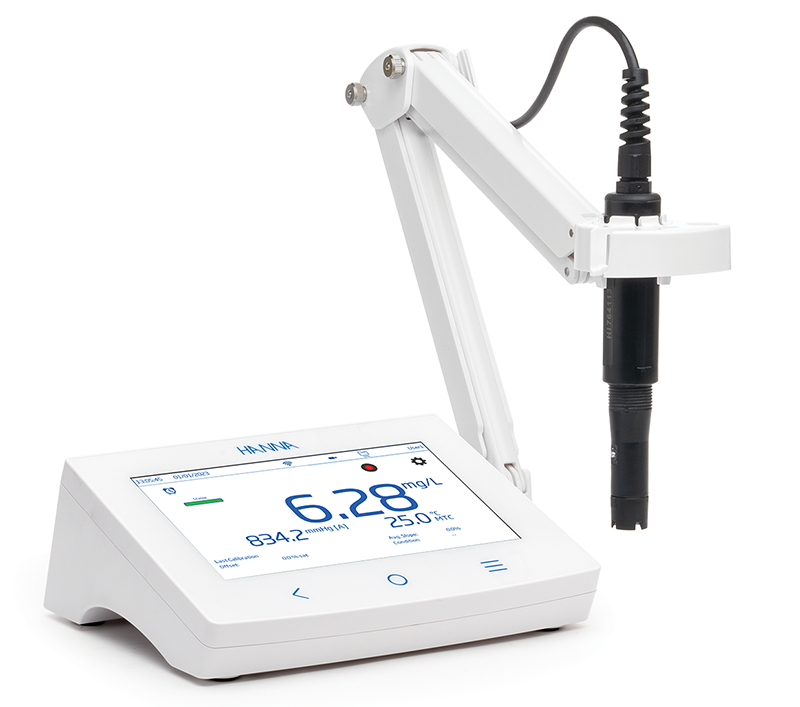
User interface
- 7-inch capacitive touch screen with multi-touch support
- Capacitive touch back, home and system menu keys
- User-friendly icons and symbols allow users to easily navigate and interpret the instrument functions
The user can select between five different views:
- Basic measurement configuration
- Simple GLP with calibration information
- Full GLP with electrode status and calibration point details
- Live updated, interactive graph
- Tabulated data with date, time, and notes
Measurement
- Measure %Sat, mg/L, ppm (DO); mg/L, ppm (BOD); mg/L (OUR); ppm, mg/L (SOUR)
- Application-specific profiles allow quick and direct measurement without the need to update the
sensor and system settings - Active log during measurement Measurement stability indicator (using the Stability Criteria setting)
- Reading modes: direct and direct/auto-hold
- Temperature compensation can be Automatic or set manually
- Audible and/or alarm messages for measurements outside of predefined limits
- Galvanic isolation for measurement
Calibration
- One or two points calibration at 0% and/or 100% saturation
- Single point manual calibration in mg/L or % saturation using a reference method
- Non-volatile memory saves data and settings
Logging
- Data log collection of at least 1,000,000 data points (with time and date stamp)
- Logging types: manual, automatic, auto-hold
- Sample ID for manual and auto-hold data
Connectivity features & services
- Transfer logged data ta USB thumb drive
- Log files that include measurements and calibration data (as .csv file)
- FTP and email for log export via Ethernet and Wi-Fi connection
- USB type A for USB stick, keyboard, and printer
- USB type C for USB stick and PC connection
Help section for meter guidance
- Video support presentation of main functionalities
Fresh water and saltwater applications, aquaculture, aquariums, environmental.
https://hanna-worldwide.com/media/product-video/HI6000-Series-Top-Benefits-video.mp4?_=1
HI6421P is supplied with HI764833 polarographic probe; HI764060 electrode holder; capillary pipette; 24 VDC power adapter; USB-C to USB-A cable; probe quality certificate; quick reference guide with instrument quality certificate.
HI76483 polarographic dissolved oxygen probe
HI76483A/P DO membranes
HI7041S refilling electrolyte solution, 30 mL
HI7041M refilling electrolyte solution, 230 mL
HI7041L refilling electrolyte solution, 500 mL
| SKU | HI6421P-02 |
|---|---|
| Product Name | Advanced Dissolved Oxygen Benchtop Meter with Polarographic DO Probe – HI6421P |
| Quote Required | Yes |
| DO (HI764833 Polarographic probe) Range | 0.00 to 90.00 mg/L (ppm) concentration; 0.0 to 600.0 % saturation |
| DO (HI764833 Polarographic probe) Resolution | 0.01 mg/L (ppm); 0.1 % saturation |
| DO (HI764833 Polarographic probe) Accuracy | ±1.5 % of reading ±1, least significant digit |
| Barometric Pressure Range | 450 to 850 mmHg; 600 to 1133 mBar; 60 to 133 kPa; / 17 to 33 inHg; 8.7 to 16.4 psi; 0.592 to 1.118 atm |
| Barometric Pressure Resolution | 1 mmHg; 1 mBar; 1 kPa; 1 inHg; 0.1 psi; 0.001 atm |
| Barometric Pressure Accuracy | ±3 mmHg within ±15 % from the calibration point / ±3 mmHg ±1 least significant digit |
| Temperature Range | −20.0 to 120.0 °C / −4.0 to 248.0 °F / 253.0 to 393.0 K |
| Temperature Resolution | 0.1 °C; 0.1 °F; 0.1 K |
| Temperature Accuracy | ±0.2 °C; ±0.4 °F; ±0.2 K |
| DO Calibration Points | Automatic-two points / User standard-single point |
| DO Calibration Standards | 0 and 100% saturation |
| DO Calibration Reminder | Disabled / Daily |
| Temperature Compensation | Automatic or Manual |
| Reading Modes | Direct Direct/Autohold |
| Reading Stability criteria | Accurate Medium Fast |
| Reading Isopotential | 7.000 or 4.010 |
| Reading Sampling rate | 1000 ms |
| DO Views Basic | Measurement (DO, Temperature) Stability status |
| DO Views Simple GLP | Basic view information Last calibration date, offset, average slope |
| DO Views Full GLP | Simple GLP information and calibration point details |
| DO Views Table | Measurements updated every second are displayed in table |
| DO Views Graph (Plot) | Measurement versus time graph can be panned or zoomed (pinch-to-zoom technology) |
| Logging Type | Automatic, Manual, Autohold |
| Logging Number of records | 50 000 maximum per file Stores at least 1 000 000 data points per user |
| Logging Automatic interval | 1, 2, 5, 10, 30 seconds / 1, 2, 5, 10, 15, 30, 60, 120, 150, 180 minutes |
| Logging Sample ID | Incremental mode |
| Logging Export option | .csv file format |
| Users | Up to 9 users and the default administrator account |
| Connectivity USB-A | 2 ports for keyboard input or USB thumb drive |
| Connectivity USB-C | 1 port for PC connectivity and USB-C type thumb drive |
| Connectivity Wi-Fi & Ethernet | FTP / Web server Log transfer and download Email |
| Connectivity RS232 | Connecting peripherals |
| Power supply | DC adapter 100-240AC to 24VDC 2.5A |
| Environment | 0 – 50 °C / 32 – 122 °F / 273 – 323 K maximum 95% RH non-condensing |
| Dimensions | 205 x 160 x 77 mm (8.0 x 6.2 x 3.0 “) |
| Weight | Approximately 1.2 kg (26.5 lbs.) |
HI6421 is a streamlined benchtop meter with a large touch screen display, comprised of a housing and an integrated module designed for fresh and saltwater measurements of dissolved oxygen.
HI6421 includes Hanna’s HI7641133 optical dissolved oxygen probe (opdo®) that is based on the principle of fluorescence quenching. An immobilized Pt-based luminophore is excited by the light of a blue LED and emits a red light. As oxygen interacts with the luminophore it reduces the intensity and lifetime of the luminescence. The lifetime of the luminescence is measured by a photodetector and is used to calculate the dissolved oxygen concentration.
The probe is fitted with easy to use Smart Caps (HI764113-1) which lock in place and contain pre-loaded calibration coefficients that are automatically transmitted to the probe. The Smart Cap features an immobilized O₂ sensitive luminophore with rugged insoluble black oxygen permeable protective layer. Over time, the sensor’s optical components can age but are compensated for by using the reference signal to compensate the measuring path. As a result, the sensor provides accurate DO measurements over long periods of time without the need for frequent calibration. Concentration measured. Additional features include built-in methods and calculations for the measurement of BOD (Biological Oxygen Demand), OUR (Oxygen Uptake Rate), and SOUR (Specific Oxygen Update Rate). Pressure compensation is done automatically (built-in barometer) or users have the option to manually enter required value. Pressure is displayed in user-configurable units: mmHg, mbar, kPa, inHg, psi, atm.
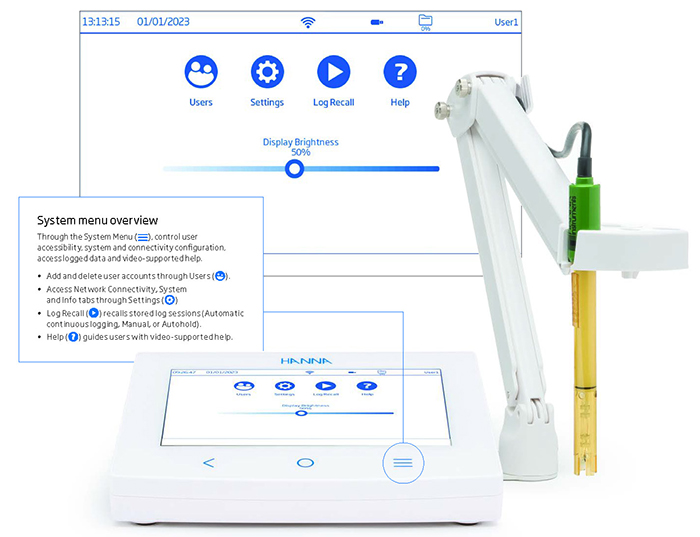
User interface
- 7-inch capacitive touch screen with multi-touch support
- Capacitive touch back, home and system menu keys
- User-friendly icons and symbols allow users to easily navigate and interpret the instrument functions
The user can select between five different views:
- Basic measurement configuration
- Simple GLP with calibration information
- Full GLP with electrode status and calibration point details
- Live updated, interactive graph
- Tabulated data with date, time, and notes
Measurement
- Measure %Sat, mg/L, ppm (DO); mg/L, ppm (BOD); mg/L (OUR); ppm, mg/L (SOUR)
- Application-specific profiles allow quick and direct measurement without the need to update the
sensor and system settings - Active log during measurement Measurement stability indicator (using the Stability Criteria setting)
- Reading modes: direct and direct/auto-hold
- Temperature compensation can be Automatic or set manually
- Audible and/or alarm messages for measurements outside of predefined limits
- Galvanic isolation for measurement
Calibration
- One or two points calibration at 0% and/or 100% saturation
- Single point manual calibration in mg/L or % saturation using a reference method
- Non-volatile memory saves data and settings
Logging
- Data log collection of at least 1, 000, 000 data points (with time and date stamp)
- Logging types: manual, automatic, auto-hold
- Sample ID for manual and auto-hold data
Connectivity features & services
- Transfer logged data ta USB thumb drive
- Log files that include measurements and calibration data (as .csv file)
- FTP and email for log export via Ethernet and Wi-Fi connection
- USB type A for USB stick, keyboard, and printer
- USB type C for USB stick and PC connection
Help section for meter guidance
- Video support presentation of main functionalities
HI6421 is supplied with HI7641133 optical dissolved oxygen probe (opdo®); HI764060 electrode holder; capillary pipette; 24 VDC power adapter; USB-C to USB-A cable; probe quality certificate; quick reference guide with instrument quality certificate.
HI7641133 optical dissolved oxygen probe (opdo®)
HI764113-1 Smart cap with O-ring
HI764113-2 Calibration/storage vessel
HI764113-3 Stainless steel protective shield
| SKU | HI6421-02 |
|---|---|
| Product Name | Advanced Dissolved Oxygen Benchtop Meter with Optical DO Probe (opdo®) – HI6421 |
| Quote Required | Yes |
| DO (HI7641133 Optical probe) Range | 0.00 to 50.00 mg/L (ppm) concentration; 0.0 to 500.0 % saturation |
| DO (HI7641133 Optical probe) Resolution | 0.01 mg/L (ppm); 0.1 % saturation |
| DO (HI7641133 Optical probe) Accuracy | from 0.00 to 20.00 mg/L (ppm) 1.5 % of reading or ± 0.01 mg/L (ppm), whichever is greater from 20.00 to 50.00 mg/L (ppm) ±5 % of reading from 0.0 to 200.0 % saturation ± 1.5 % of reading or ± 0.1 %, whichever is greater from 200.0 to 500.0 % saturation ±5 % of reading |
| Barometric Pressure Range | 450 to 850 mmHg; 600 to 1133 mBar; 60 to 133 kPa; 17 to 33 inHg; 8.7 to 16.4 psi; 0.592 to 1.118 atm |
| Barometric Pressure Resolution | 1 mmHg; 1 mBar; 1 kPa; 1 inHg; 0.1 psi; 0.001 atm |
| Barometric Pressure Accuracy | ±3 mmHg within ±15 % from the calibration point ±3 mmHg ±1 least significant digit |
| Temperature Range | −20.0 to 120.0 °C −4.0 to 248.0 °F 253.0 to 393.0 K |
| Temperature Resolution | 0.1 °C; 0.1 °F; 0.1 K |
| Temperature Accuracy | ±0.2 °C; ±0.4 °F; ±0.2 K |
| DO Calibration Points | One or two points automatic calibration at 100% (8.26 mg/L) and 0% (0 mg/L). Single point manual using a value entered by the user in % saturation or mg/L. |
| DO Calibration Standards | 0 and 100% saturation |
| DO Calibration Reminder | Disabled Daily |
| Temperature Compensation | Automatic or Manual |
| Salinity Compensation | Automatic from 0 to 70 PSU (manually set) 0.0 to 70.0 % / 0.0 to 45.0 g/L / 0.0 to 42.0 psu |
| Reading Modes | Direct Direct/Autohold |
| Reading Stability criteria | Accurate Medium Fast |
| Reading Isopotential | 7.000 or 4.010 |
| Reading Sampling rate | 1000 ms |
| DO Views Basic | Measurement (DO, Temperature) Stability status |
| DO Views Simple | GLP Basic view information Last calibration date, offset, average slope |
| DO Views Full | GLP Simple GLP information and calibration point details |
| DO Views Table | Measurements updated every second are displayed in table |
| DO Views Graph (Plot) | Measurement versus time graph can be panned or zoomed (pinch-to-zoom technology) |
| Logging Type | Automatic, Manual, Autohold |
| Logging Number of records | 50 000 maximum per file Stores at least 1 000 000 data points per user |
| Logging Automatic interval | 1, 2, 5, 10, 30 seconds / 1, 2, 5, 10, 15, 30, 60, 120, 150, 180 minutes |
| Logging Sample ID | Incremental mode |
| Logging Export option | .csv file format |
| Users | Up to 9 users and the default administrator account |
| Connectivity USB-A | 2 ports for keyboard input or USB thumb drive |
| Connectivity USB-C | 1 port for PC connectivity and USB-C type thumb drive |
| Connectivity Wi-Fi & Ethernet | FTP / Web server Log transfer and download Email |
| Connectivity RS232 | Connecting peripherals |
| Power supply | DC adapter 100-240AC to 24VDC 2.5A |
| Environment | 0 – 50 °C / 32 – 122 °F / 273 – 323 K maximum 95% RH non-condensing |
| Dimensions | 205 x 160 x 77 mm (8.0 x 6.2 x 3.0 “) |
| Weight | 1.2 kg (26.5 lbs.)1 |